What is correct tongue posture?
At rest, the whole tongue should sit lightly against the roof of the mouth, with the tip just behind (not touching) the upper front teeth. The lips are closed, the teeth are slightly apart, and you breathe through your nose.
To find the spot, say "n": where the tip of your tongue lands is roughly where it should rest. Then let the middle and back of the tongue lift gently to the palate too.
Tongue habits that affect teeth
| Habit | What it looks like | Possible effect |
|---|---|---|
| Tongue thrust swallow | Tongue pushes forward between or against the front teeth on swallowing | Front teeth tipped forward, open bite, gaps |
| Low tongue rest | Tongue lies on the floor of the mouth | Narrow upper jaw in children; crossbite |
| Mouth breathing | Lips apart at rest, snoring, dry lips | Long face growth pattern, narrow palate, gum irritation |
| Tongue tie | Tongue can't lift to the palate | Low tongue posture, speech or feeding issues |
Why it matters most in children
Jaws are still growing in children, so steady pressure from the tongue, lips and cheeks can shape the dental arches. A tongue that rests low and pushes forward is linked with proclined front teeth, open bites and crossbites. Mouth breathing from blocked noses or enlarged tonsils often comes with low tongue posture.
In adults the bones have stopped growing, so tongue posture alone won't reshape the jaw, but a tongue thrust can still push teeth after braces, which is one reason retainers matter.
Simple tongue posture exercises
- 1
Spot hold
Place the tip on the spot behind your upper front teeth and hold for 1 minute, a few times a day.
- 2
Tongue suction
Suck the whole tongue up to the palate, hold for 5 seconds, release. Repeat 10 times.
- 3
Correct swallow
With the tongue tip on the spot and teeth together, swallow a sip of water without the tongue pushing forward.
- 4
Lip seal
Keep lips closed and breathe through the nose while reading or watching TV.
For children with a strong habit, an orthodontist or a trained therapist (orofacial myofunctional therapy) can guide exercises, and sometimes a small appliance reminds the tongue where to go.
What about mewing?
"Mewing" is the online trend of pressing the tongue hard against the palate to reshape the jaw. Good resting tongue posture is sensible, but there's no reliable scientific evidence that mewing changes the jawline or face shape in adults. Pressing too hard for long periods may strain jaw muscles. If you're worried about your jaw or bite, see an orthodontist.
Check the cause before the habit
Most guides jump straight to exercises. But many children hold their tongue low because they can't breathe well through the nose. Before tongue training, check for these:
- Snoring or noisy breathing at night
- Constant blocked nose, allergies or frequent colds
- Large tonsils or adenoids (ask a paediatrician or ENT)
- A tight tongue tie that stops the tongue lifting
- Dark circles under the eyes or daytime tiredness
Treating the airway problem first makes tongue exercises far more likely to work. Our children's dentist can check the bite and refer you if needed.
Tongue posture,
answered
Can't find your answer? We're one call away.
Call +91 76039 55135
Against the roof of your mouth, with the tip just behind your upper front teeth, lips closed, teeth slightly apart and breathing through the nose.
In growing children, a tongue that rests low or pushes forward can contribute to protruding teeth, open bites and crossbites. It's one factor among several, including genetics.
There's no reliable evidence that mewing reshapes the adult jaw or face. Correct resting posture is healthy, but it won't replace orthodontic or surgical treatment.
Swallowing exercises, nasal breathing and sometimes a habit appliance help. An orthodontist or myofunctional therapist can tailor a plan, especially for children.
Infants swallow with the tongue forward. It normally changes as children grow; if it persists past about 6 to 7 years, have it checked.
Research behind this guide
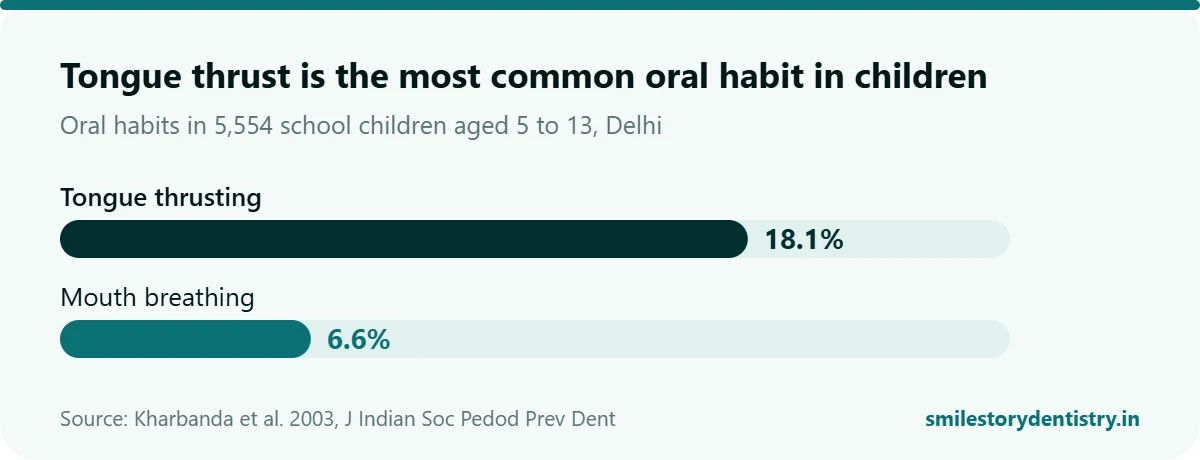
- Kharbanda OP et al. Oral habits in school going children of Delhi: a prevalence study. J Indian Soc Pedod Prev Dent, 2003
- Dixit UB, Shetty RM. Comparison of soft-tissue, dental, and skeletal characteristics in children with and without tongue thrusting habit. Contemp Clin Dent, 2013
- Healthline. What you need to know about proper tongue posture
- Colgate. What is proper tongue posture and why does it matter?
This guide is for general information and does not replace a dental examination. Every mouth is different, so book a consultation for advice on your own teeth.