Why do teeth move back after braces?
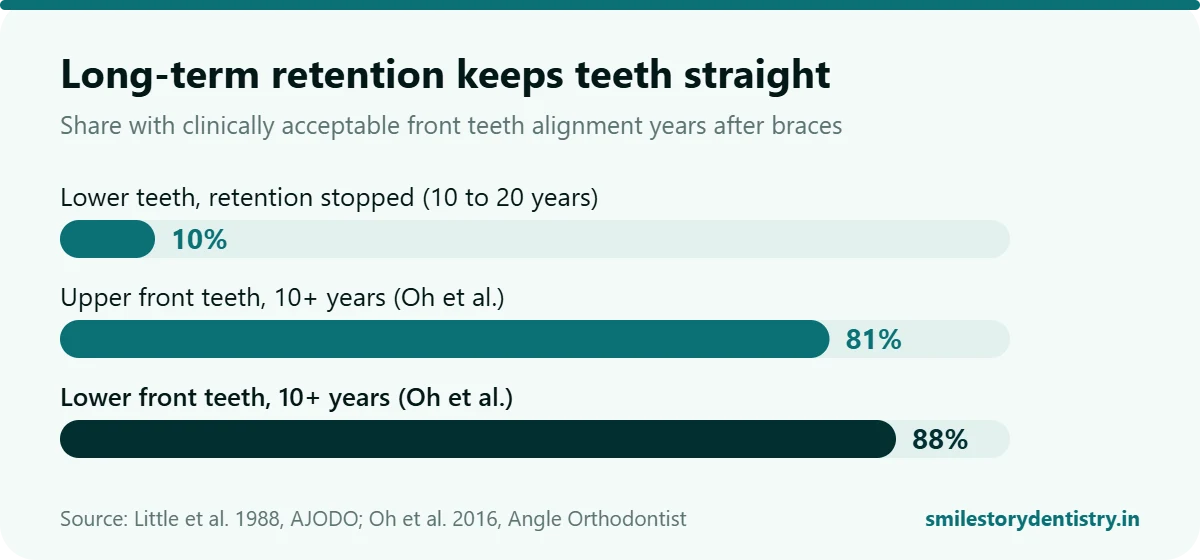
Teeth sit in bone, held by elastic fibres. When braces move a tooth, the bone and fibres around it need months to reorganise, and some gum fibres keep a "memory" of the old position for a year or more. On top of that, the jaws keep changing shape through life, which is why lower front teeth tend to crowd with age even in people who never had braces.
A retainer holds the teeth while that settling happens, and long term against the slow natural drift.
Types of retainers
| Type | What it is | Pros | Cons |
|---|---|---|---|
| Fixed (bonded) retainer | Thin wire glued behind the front teeth | Always working; nothing to remember | Harder to clean; can debond or break |
| Clear removable retainer | Thin plastic tray, like an aligner | Invisible, comfortable | Can be lost; wears out; must be worn |
| Hawley retainer | Acrylic plate with a metal wire | Durable, adjustable | Visible wire; slight effect on speech at first |
Many orthodontists use a combination: a fixed wire on the lower front teeth plus a removable retainer at night. Read more on fixed retainers.
How long should you wear a retainer?
| Period | Typical removable retainer wear |
|---|---|
| First 3 to 6 months | Full time, about 20 to 22 hours a day; out only to eat and clean |
| Next 6 to 12 months | Every night |
| After that | Nightly, or a few nights a week if your orthodontist agrees |
| Long term | For as long as you want straight teeth |
Your orthodontist will tailor this. If the retainer feels tight after a missed night or two, that's a sign your teeth were starting to move; wear it more.
How to look after your retainer
- 1
Clean it daily
Brush gently with a soft brush and mild soap or the cleaner your orthodontist recommends. Toothpaste can scratch clear retainers.
- 2
Keep it cool
Hot water and car dashboards warp plastic retainers.
- 3
Use the case
Most lost retainers are wrapped in a tissue at a meal and thrown away.
- 4
Brush before putting it in
Trapped food and sugary drinks under a retainer raise decay risk.
- 5
Bring it to check-ups
Retainers wear out; your dentist can check the fit.
Lost, broken or tight retainer?
- Lost or cracked: call within a few days; teeth can move in weeks
- Tight after a gap in wear: wear it full time for a few days if it still goes in comfortably
- Doesn't fit at all: don't force it; get your teeth checked
- Fixed wire loose or broken: book a repair; keep the wire clean and avoid biting hard foods with front teeth
The retainer habit that lasts
Most people stop wearing retainers not by choice but by drifting out of the habit. These small things make it stick:
- Keep the case next to your toothbrush, not in a drawer
- Put it in as the last step of brushing at night, every night
- Order a spare retainer once your teeth have settled
- Set a phone reminder for the first 6 months
- Take a photo of your smile on the day braces come off, to compare later
Retainers,
answered
Can't find your answer? We're one call away.
Call +91 76039 55135
Most orthodontists now advise long-term night-time wear, because teeth can shift throughout life. After the first year, many people wear a removable retainer a few nights a week.
Teeth can gradually move back, especially the lower front teeth. Small shifts may need aligners to correct.
Each has pros and cons. Fixed retainers work all the time but need careful cleaning. Removable ones are easier to clean but depend on you wearing them. Many people use both.
Remove removable retainers to eat and drink anything but water. Fixed retainers stay in, but avoid biting very hard foods with your front teeth.
Clear removable retainers often need replacing every 1 to 3 years. Fixed retainers can last many years if they stay bonded.
Research behind this guide
- Little RM, Riedel RA, Artun J. An evaluation of changes in mandibular anterior alignment from 10 to 20 years postretention. Am J Orthod Dentofacial Orthop, 1988
- Oh H et al. Evaluation of posttreatment stability after orthodontic treatment in the mixed and permanent dentitions. Angle Orthodontist, 2016
- Little RM. Stability and relapse of mandibular anterior alignment: University of Washington studies. Seminars in Orthodontics, 1999
- Colgate. Retainers after braces: types and maintenance
This guide is for general information and does not replace a dental examination. Every mouth is different, so book a consultation for advice on your own teeth.