Types of crossbite
| Type | What you see | Common cause |
|---|---|---|
| Anterior (front) | One or more upper front teeth bite behind the lower ones | Tooth position, or a jaw that grows forward |
| Posterior (back), one side | Upper back teeth bite inside the lower back teeth on one side; jaw may shift | Narrow upper jaw, often from thumb sucking or mouth breathing |
| Posterior, both sides | Upper back teeth inside on both sides | Narrow upper jaw |
| Single tooth | One tooth caught behind its opposite | Crowding or a tooth erupting at an angle |
Teeth problem or jaw problem?
A dental crossbite means the teeth are tipped out of position while the jaws are fine; it's usually quick to fix with braces or a simple appliance. A skeletal crossbite means the jaws themselves are mismatched, for example an upper jaw that's too narrow. In growing children this can be corrected by widening the upper jaw; in adults it may need braces combined with surgery.
A functional crossbite is when the jaw slides sideways to fit the teeth together. It's important to catch, because the jaw can grow lopsided if it stays shifted.
Problems an untreated crossbite can cause
- Uneven wear and chipping of the teeth caught in the crossbite
- Gum recession on lower front teeth pushed forward by an upper tooth
- Jaw shifting to one side, which can lead to uneven jaw growth in children
- Strain on the jaw muscles and joints in some people
- Facial asymmetry in long-standing one-sided crossbites
How crossbites are corrected
| Option | Best for | Typical time |
|---|---|---|
| Palatal expander | Children with a narrow upper jaw | Widening over weeks, then held 3 to 6 months |
| Removable appliance with spring | Single front tooth crossbite in children | A few months |
| Braces | Most dental crossbites, any age | 12 to 24 months |
| Clear aligners | Mild dental crossbites | 6 to 18 months |
| Surgically assisted expansion or jaw surgery | Adults with skeletal crossbites | Planned with an orthodontist and surgeon |
Learn about braces and aligners at Smile Story.
A parent's check: does the jaw slide?
The research highlights functional crossbites as the ones most worth catching early. You can check your child at home:
- 1
Look at the centre
With your child's lips apart and teeth together, does the gap between the top two front teeth line up with the gap between the bottom two?
- 2
Watch them close
Ask them to open wide, then close slowly. Does the lower jaw slide to one side at the last moment?
- 3
Check the sides
Pull the cheek gently. Do the upper back teeth sit outside the lower ones, like a lid on a box?
- 4
Book if unsure
A midline that doesn't match, a sideways slide or a tooth caught behind is worth a visit with our children's dentist.
Crossbites,
answered
Can't find your answer? We're one call away.
Call +91 76039 55135
Most crossbites are worth treating, because they can cause uneven tooth wear, gum recession or lopsided jaw growth in children. A dentist can tell you how urgent yours is.
Rarely. Some crossbites in baby teeth correct when adult teeth arrive, but most persist. Stopping thumb sucking early can help prevent them.
Yes. Dental ones are treated with braces or aligners. Those caused by the jaw bones may need surgery combined with braces in adults.
Children usually feel pressure for a few minutes after each turn and may notice a gap opening between the front teeth, which is expected and closes later.
Back crossbites from a narrow jaw are easiest to treat while the jaw is still growing, often between 7 and 10. Front tooth crossbites should be treated once noticed.
Research behind this guide
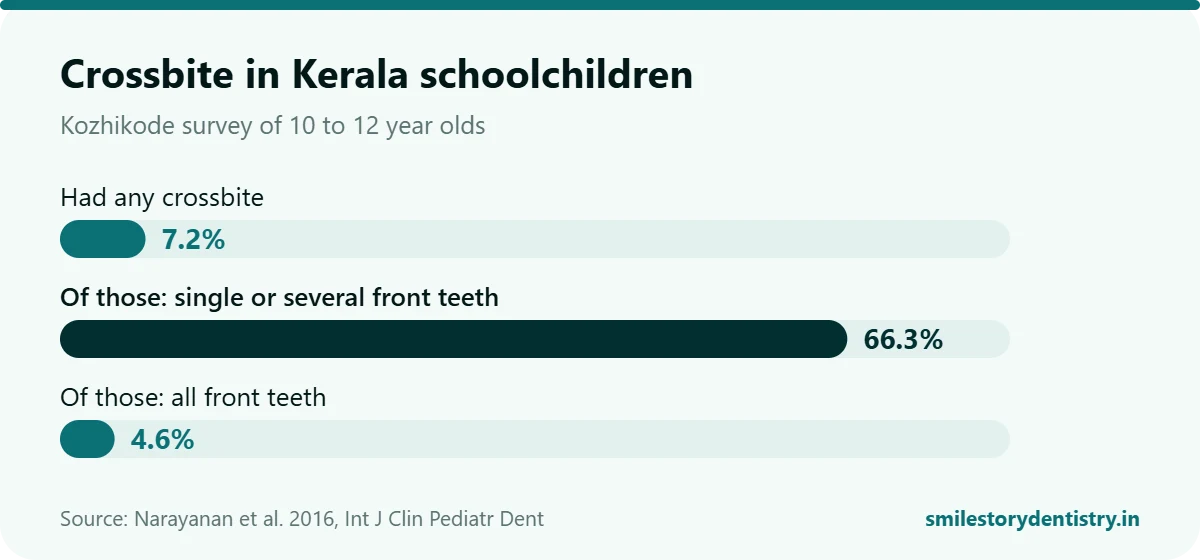
- Narayanan RK et al. Prevalence of malocclusion among 10–12-year-old schoolchildren in Kozhikode district, Kerala. Int J Clin Pediatr Dent, 2016
- Lombardo G et al. Worldwide prevalence of malocclusion in the different stages of dentition. Eur J Paediatr Dent, 2020
- Crossbite: an orthodontic exigency (2016)
- An Introduction to Orthodontics: crossbites
This guide is for general information and does not replace a dental examination. Every mouth is different, so book a consultation for advice on your own teeth.