Do cavities in baby teeth matter?
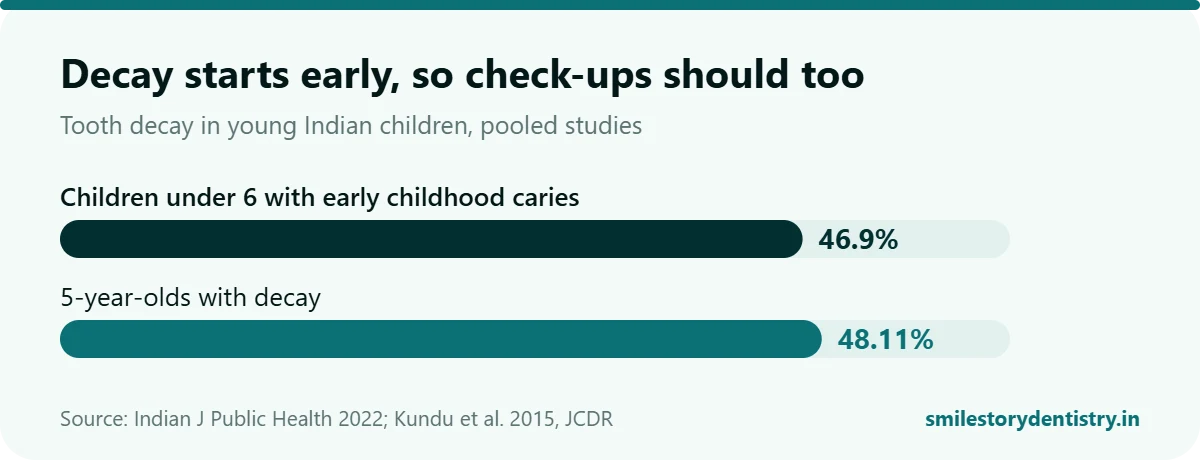
Yes. Baby teeth help children chew, speak clearly and smile with confidence, and they hold space for the adult teeth. Decay spreads faster in baby teeth because their enamel is thinner. Untreated, it can cause pain, infection, missed school and sleep, and early tooth loss that leads to crowding later.
What causes cavities in children?
| Cause | Why |
|---|---|
| Bottle or breastfeeding to sleep, after teeth arrive | Milk pools around the teeth all night |
| Frequent sweets, biscuits and juice | Each snack starts a 20 to 30 minute acid attack |
| Sticky foods | Chocolates, toffees and chips cling to grooves |
| Not brushing twice daily, or brushing alone too young | Children can't clean well alone until about 7 or 8 |
| No fluoride toothpaste | Fluoride strengthens enamel against acid |
| Sharing spoons or pre-chewing food | Can pass decay-causing bacteria from parent to child |
| Deep grooves in molars | Food traps; sealants help |
Early signs of cavities in children
- Chalky white lines along the gumline of upper front teeth (the earliest sign)
- Brown or black spots or holes
- Food getting stuck in the same place
- Avoiding chewing on one side, or refusing cold foods
- Toothache, swelling, or a pimple on the gum
- Bad breath that doesn't go away with brushing
A prevention plan by age
| Age | What to do |
|---|---|
| Birth to first tooth | Wipe gums with a clean, damp cloth after feeds |
| First tooth to 3 years | Brush twice daily with a rice-grain smear of fluoride toothpaste; no bottle in bed; first dental visit by age 1 |
| 3 to 6 years | Pea-sized fluoride toothpaste, parent brushes; limit sweets to mealtimes |
| 6 to 9 years | Child brushes, parent finishes; ask about sealants on new molars |
| All ages | Water between meals, check-ups every 6 months, fluoride varnish if advised |
How cavities are treated in children
- Fluoride varnish to stop very early decay
- Tooth-coloured fillings for small cavities
- Silver diamine fluoride, a painless liquid that can arrest decay in young or anxious children (it stains the decay dark)
- Stainless steel or tooth-coloured crowns for badly decayed baby molars
- Pulp treatment (a "baby root canal") when decay reaches the nerve
- Space maintainers if a baby tooth has to be removed early
Our children's dentistry focuses on gentle, positive first visits.
Count the sugar moments, not the sugar
Most guides say "cut down on sugar". The research on decay points more precisely at how often teeth are exposed. Each sweet snack or sip of juice starts an acid attack lasting about 20 to 30 minutes. Five small sweets spread through the day can do more harm than the same amount eaten at once after a meal.
Try this for a week: count your child's "sugar moments", every time something sweet touches their teeth, including biscuits, juice, flavoured milk and sweet tea. Aim to bring it down to 4 or fewer a day, kept to mealtimes, with only water between meals.
Children's cavities,
answered
Can't find your answer? We're one call away.
Call +91 76039 55135
By the first birthday, or within 6 months of the first tooth appearing. Early visits catch problems and help children get comfortable.
Yes, in the right amount: a rice-grain smear under 3, and a pea-sized amount from 3 to 6. Supervise brushing so they spit rather than swallow.
Usually, yes. Some baby molars stay until 10 to 12 years old, and untreated decay can cause pain, infection and crowding of adult teeth.
Sealants protect the deep grooves of molars, where most children's cavities start. They're painless and often recommended when adult molars come in around 6 and 12.
Very early decay can be stopped with fluoride varnish or silver diamine fluoride. Larger cavities usually need a filling or crown.
Research behind this guide
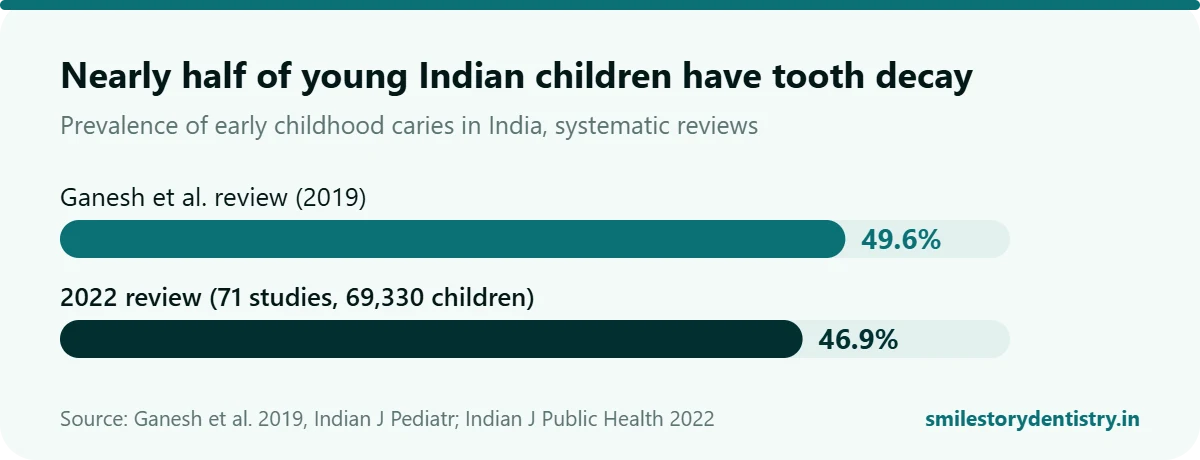
- Prevalence of early childhood caries in India: a systematic review and meta-analysis. Indian Journal of Public Health, 2022
- Ganesh A et al. Prevalence of early childhood caries in India: a systematic review. Indian Journal of Pediatrics, 2019
- Kundu H et al. Dental caries scenario among 5, 12 and 15-year-old children in India: a retrospective analysis. JCDR, 2015
- Johns Hopkins Medicine. Tooth decay (caries or cavities) in children
This guide is for general information and does not replace a dental examination. Every mouth is different, so book a consultation for advice on your own teeth.