Why do my gums bleed when I brush?
In most people, it's plaque. The sticky film of bacteria that builds up along the gumline irritates the gums, and they respond by swelling and filling with extra blood. Inflamed gum tissue is fragile, so the brush breaks the surface and you see pink in the sink. Dentists call this gingivitis.
The good news is that gingivitis is reversible. Once the plaque is removed every day, the swelling settles and the bleeding stops. If it's ignored, the inflammation can spread to the bone that holds the teeth, which is called periodontitis, and that damage is permanent.
How many people have bleeding gums?
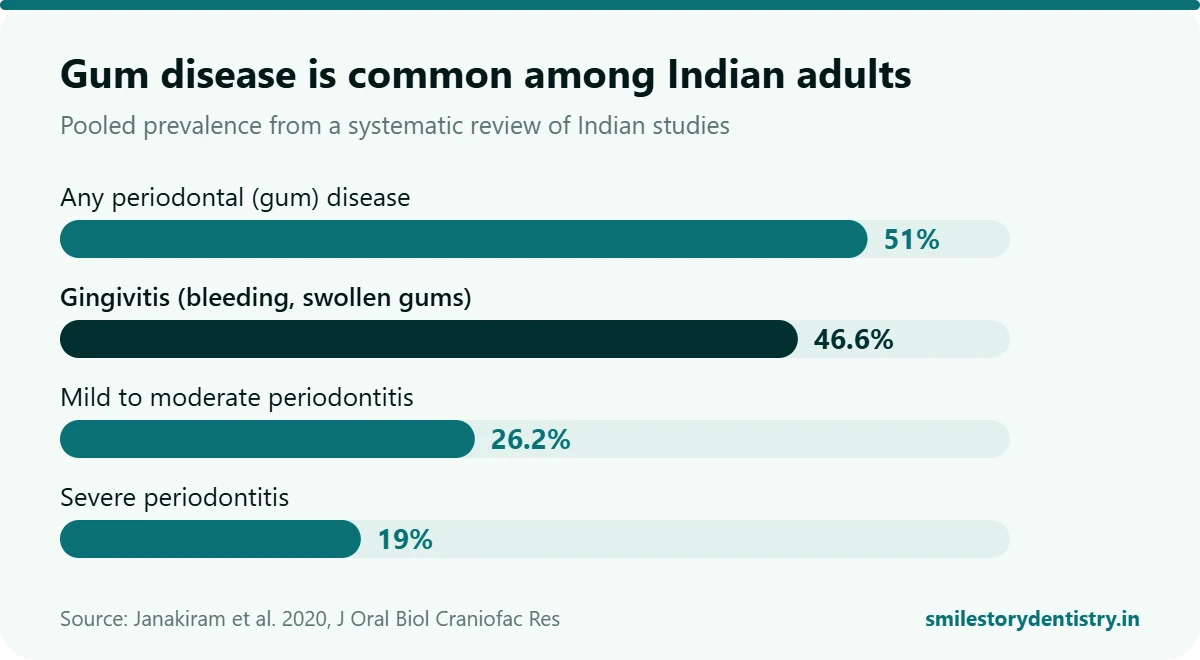
A systematic review of Indian studies found that about half of adults have some form of gum disease, and 46.6% have gingivitis.
Because it rarely hurts, many people don't realise they have it until a dentist points it out.
What causes gums to bleed?
| Cause | Clue | What helps |
|---|---|---|
| Plaque and gingivitis | Bleeding in the same spots daily, puffy red gum edges, bad breath | Better brushing and cleaning between teeth, plus a professional cleaning |
| Tartar (calculus) | Hard yellow or brown deposits near the gums, especially behind lower front teeth | Only a dental cleaning can remove it |
| Brushing too hard or a hard brush | Gums sore and receding, bristles splayed within weeks | Soft brush, gentle circles |
| Starting to floss | Bleeding only where you've just begun flossing | Keep going; it usually stops within 1 to 2 weeks |
| Pregnancy and hormones | Swollen, bleeding gums during pregnancy, puberty or around periods | Extra care and a dental check during pregnancy |
| Blood thinners and some medicines | Bleeding that is slow to stop, bruising elsewhere | Tell your dentist and doctor; don't stop the medicine yourself |
| Uncontrolled diabetes | Gum problems that keep coming back, frequent infections | Blood sugar control and gum treatment together |
| Vitamin C or K deficiency | Bleeding with poor diet, easy bruising, slow healing | Diet changes or supplements after a blood test |
| Smoking or chewing tobacco | Gums may bleed less, hiding the disease | Quitting; regular checks for gum disease and mouth cancer |
| Blood disorders (rare) | Bleeding from gums without brushing, nosebleeds, bruises | See a doctor promptly for blood tests |
How to stop gums bleeding at home
Most early gingivitis settles in 10 to 14 days if you follow these steps every day. Don't stop brushing because of the bleeding; that lets plaque build up and makes it worse.
- 1
Switch to a soft brush
Hold it at 45 degrees to the gumline and use small, gentle circles for two minutes, twice a day.
- 2
Clean between the teeth daily
Use floss or an interdental brush. Expect some bleeding for the first week; it should reduce as the gums heal.
- 3
Use fluoride toothpaste
Spit after brushing but don't rinse with water, so the fluoride stays on the teeth.
- 4
Rinse with salt water
Half a teaspoon of salt in a glass of warm water can soothe sore gums. It doesn't replace brushing.
- 5
Eat for your gums
Fruit and vegetables rich in vitamin C, such as amla, guava and oranges, support gum repair. Cut down on sugary snacks between meals.
- 6
Book a cleaning
If tartar is present, no amount of brushing will remove it. A scaling and polishing removes it so your home care can work.
When are bleeding gums serious?
See a dentist if any of these apply. They suggest the problem has gone beyond simple gingivitis, or that something else is going on.
- Bleeding that hasn't improved after 2 weeks of careful cleaning
- Gums that look like they're pulling away, making teeth look longer
- Loose teeth, or a change in how your teeth fit together
- Pus between the teeth and gums, or a bad taste that doesn't go away
- Bleeding without brushing, or with bruising or nosebleeds elsewhere (see a doctor too)
- Bleeding gums with diabetes, during pregnancy, or while on blood thinners
How dentists treat bleeding gums
First, a dentist checks how deep the spaces between your gums and teeth are, and may take X-rays to look at the bone. For gingivitis, a professional cleaning (scaling and polishing) plus better home care is usually all that's needed.
If the gums have started to separate from the teeth, a deeper cleaning below the gumline, called root planing, removes hardened deposits from the roots. Advanced cases may need gum surgery. Regular cleanings every 3 to 6 months keep things stable. Learn more about our gum treatment.
Bleeding gums and blood sugar: a two-way link
Most guides list diabetes as one cause among many. The research says the link runs both ways. A joint report by gum disease and diabetes experts found that diabetes raises the risk and severity of gum disease, and that gum disease makes blood sugar harder to control. Treating gum disease has been linked to a small but real drop in HbA1c.
If you have diabetes, or someone in your family does, treat bleeding gums as a health check, not just a dental one:
- Tell your dentist your latest HbA1c and the medicines you take
- Get a gum check at least twice a year, even without symptoms
- If gums bleed and you've never had a sugar test, ask your doctor for one
- Keep up gum care after treatment, since bacteria return quickly
Bleeding gums,
answered
Can't find your answer? We're one call away.
Call +91 76039 55135
No. Bleeding is a sign of plaque, and stopping lets more of it build up. Keep brushing gently with a soft brush and clean between your teeth. If it hasn't settled in 2 weeks, see a dentist.
Severe vitamin C deficiency (scurvy) and vitamin K deficiency can cause bleeding gums, but they're much less common than plaque. If you also bruise easily or eat few fruits and vegetables, ask your doctor about a blood test.
An antiseptic mouthwash can reduce plaque for a short time, but it can't replace brushing and cleaning between teeth, and it can't remove tartar. Chlorhexidine rinses can also stain teeth if used for long periods.
It's common, because hormone changes make gums react more strongly to plaque. It still needs care. A dental check and cleaning during pregnancy is safe and recommended.
Gingivitis usually improves within 10 to 14 days of thorough daily cleaning, especially after a professional scaling. Deeper gum disease takes longer and needs treatment at the clinic.
Bleeding itself doesn't, but untreated gingivitis can progress to periodontitis, which destroys the bone around teeth. That is a leading cause of tooth loss in adults.
Research behind this guide
- Janakiram C, Mehta A, Venkitachalam R. Prevalence of periodontal disease among adults in India: a systematic review and meta-analysis. J Oral Biol Craniofac Res, 2020
- Prevalence of Periodontal Disease in the General Population of India: A Systematic Review. JCDR, 2016
- Sanz M et al. Scientific evidence on the links between periodontal diseases and diabetes: consensus report. J Clin Periodontol, 2018
- Cleveland Clinic. Bleeding gums: causes and treatment
- MedlinePlus. Bleeding gums
- National Institute of Dental and Craniofacial Research. Periodontal (gum) disease
This guide is for general information and does not replace a dental examination. Every mouth is different, so book a consultation for advice on your own teeth.