What are proclined teeth?
Proclined teeth are front teeth that tilt forward at a steeper angle than normal. Dentists usually see it in the upper front teeth (incisors), but the lower ones can lean forward too. People often call them buck teeth or forwardly placed teeth.
Dentists measure it as overjet: the horizontal gap between the edges of the upper and lower front teeth when you bite. A normal overjet is about 2 to 3 mm. Above 3 to 4 mm, the teeth look prominent, and the lips may struggle to close over them without effort.
Proclination is a tilt of the teeth. Sometimes the whole upper jaw also sits forward, or the lower jaw sits back. That difference matters, because tilted teeth can be straightened with braces or aligners, while a jaw position problem may need growth guidance or surgery.
Signs your teeth may be proclined
- Your upper front teeth rest on or over your lower lip
- Your lips don't meet naturally at rest, so you strain to close them
- A side photo shows your front teeth angled outward
- You bite into food mostly with the sides of your mouth because your front teeth don't meet
- Your front teeth have been chipped more than once
- You breathe through your mouth often, especially while sleeping
How common are proclined teeth in India?
More common than most parents think. In a survey of 2,366 schoolchildren aged 10 to 12 in Kozhikode, Kerala, 23.2% had an increased overjet of more than 3 mm. In Davangere, Karnataka, 40.9% of 8 to 9 year olds had some kind of bite problem, and excessive overjet was the second most frequent finding at 9.4%.
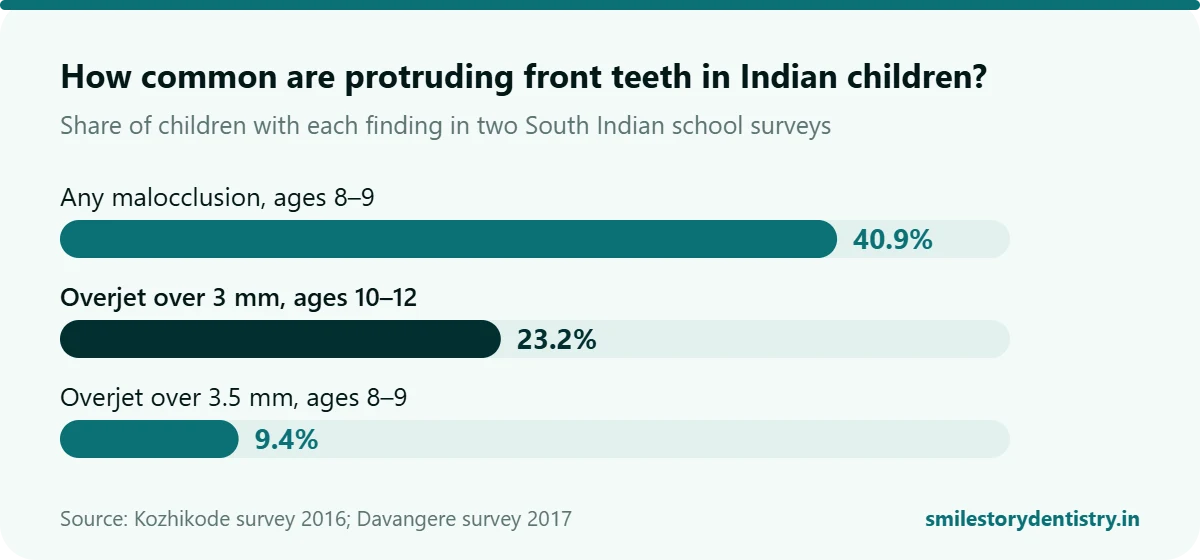
The numbers vary between studies because each one uses a slightly different cut-off and age group, but the pattern is the same: forward-tilted front teeth are one of the most frequent bite problems in Indian children.
Why do teeth become proclined?
Usually it's a mix of the jaw you inherit and the habits your mouth has had over the years.
| Cause | What happens | Can it be prevented? |
|---|---|---|
| Genetics and jaw size | A small lower jaw, a forward upper jaw, or large teeth in a small arch push the front teeth outward. | No, but early checks let a dentist guide growth. |
| Thumb or finger sucking | Steady pressure behind the upper teeth tips them forward. The longer the habit continues past the preschool years, the bigger the effect. | Yes. Helping a child stop by age 4 to 5 limits the damage. |
| Long-term pacifier or bottle use | Similar pressure to thumb sucking, more often linked to crossbites. | Yes, by weaning gradually. |
| Tongue thrusting | The tongue pushes against the front teeth each time you swallow, hundreds of times a day. | Often, with swallowing exercises. |
| Mouth breathing | Blocked nose, enlarged tonsils or adenoids keep the mouth open, so the lips stop holding the teeth back. | Often, by treating the nasal or airway problem. |
| Crowding | When there isn't room in the arch, teeth escape forward. | Partly, through space maintenance in childhood. |
| Early loss of milk teeth or adult teeth | Neighbouring teeth drift and the bite collapses, letting the front teeth flare. | Yes, with space maintainers or timely replacement. |
| Gum disease in adults | Bone loss around the front teeth lets them fan out and develop gaps. | Yes, with gum treatment and regular cleaning. |
| Lip tightness | A loose or short upper lip doesn't press back on the teeth. | Not directly, but lip exercises may help in some cases. |
Are proclined teeth just a cosmetic problem?
No. Appearance is the reason most people seek treatment, but the bigger risk is injury. Teeth that stick out take the first hit in a fall, a cricket ball or a collision on the playground.
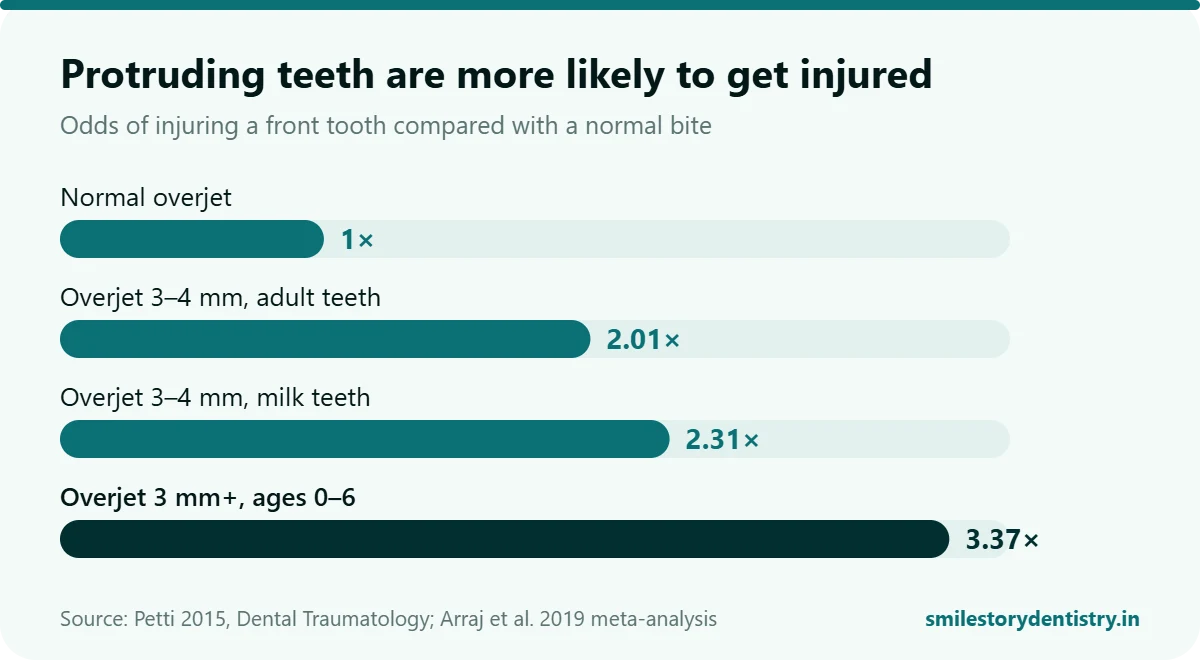
A meta-analysis by Petti in 2015 found that an overjet of 3 to 4 mm roughly doubles the odds of a front-tooth injury, and a 2019 review found the odds more than triple in children under 6 with an overjet of 3 mm or more. In Indian studies, children with an overjet of 5 mm or more and lips that don't close were clearly more likely to have broken front teeth.
Other problems include dry mouth and gum irritation from lips that stay apart, difficulty biting into food, speech changes with some sounds, and in the lower jaw, a link with gum recession on forward-tilted lower incisors.
How are proclined teeth corrected?
The right treatment depends on your age, whether the cause is the teeth or the jaw, and how far forward the teeth sit. Here is every option, from simplest to most involved.
| Treatment | Best for | Typical duration |
|---|---|---|
| Habit-breaking appliance | Children who still suck a thumb or thrust the tongue | 6 to 12 months |
| Removable or functional appliance | Growing children (about 9 to 15) with a jaw imbalance | 9 to 18 months, often followed by braces |
| Metal or ceramic braces | Most teenagers and adults with tilted teeth | 12 to 24 months |
| Clear aligners | Mild to moderate cases in adults and older teens who want discreet treatment | 6 to 18 months |
| Braces with tooth removal | Severe crowding or protrusion with no room to pull teeth back | 18 to 30 months |
| Crowns or veneers | Mild cases in adults, when the tooth angle can be disguised | 2 to 3 visits |
| Jaw surgery with braces | Adults whose jaw position is the main cause | Around 2 years in total |
After any correction, retainers hold the teeth in their new position. Without them, teeth tend to drift forward again, especially if the original habit or lip posture is still there.
Can proclined teeth be fixed without braces?
Sometimes. Clear aligners move teeth without brackets or wires and suit many mild to moderate cases. Veneers or crowns can disguise a slight forward tilt in adults, though they change how the teeth look, not where the roots sit, and they need healthy tooth structure. In young children, stopping a thumb-sucking habit early can let teeth settle back on their own.
Moderate to severe proclination, or a jaw that sits out of line, generally still needs braces, aligners with attachments, or growth appliances to fix the cause rather than cover it.
When should a child be checked?
Around age 7, when the first adult front teeth and molars are in, is a good time for a first bite check, as the American Association of Orthodontists recommends. Growth-guiding appliances work best during the growth spurt, roughly between 9 and 15, and protruding teeth can be protected from injury early instead of waiting until all the adult teeth arrive.
A children's dental check at this age also catches habits like thumb sucking early. Adults can be treated at any age. The teeth move just as well; only the jaw growth options are no longer available.
Protect proclined teeth until they're corrected
Most guides skip this, but the injury research suggests it may matter most. Correction takes months, and the risk of a broken front tooth stays high the whole time. While you plan or go through treatment:
- Wear a custom-fitted mouthguard for cricket, football, kabaddi, cycling and skating
- Ask your dentist for a guard that fits over braces if treatment has started
- Teach children to hold a lost or broken tooth piece by the crown, keep it in milk and come in within an hour
- Book a check after any blow to the mouth, even if the tooth looks fine, because cracks and nerve damage can be hidden
- Treat a blocked nose or snoring, since mouth breathing keeps the lips apart and the teeth unprotected
Proclined teeth,
answered
Can't find your answer? We're one call away.
Call +91 76039 55135
It's usually a combination of jaw shape you inherited and pressure from habits such as thumb sucking, tongue thrusting or mouth breathing. In adults, gum disease can also let front teeth fan forward. A dental exam and X-ray show which cause is behind yours.
In young children, teeth sometimes improve once a thumb-sucking habit stops early. Teeth that are still forward after the adult front teeth come in rarely straighten on their own, and they stay at higher risk of injury until treated.
For mild to moderate tilting, often yes. Aligners can tip teeth back and close small gaps. Severe protrusion or a jaw imbalance usually needs braces, growth appliances or a combined plan, so an assessment is the first step.
You may feel pressure and mild soreness for a few days after braces are fitted, adjusted, or after switching to a new aligner. Most people manage with soft foods and an over-the-counter painkiller if needed.
Not always. If the arch is crowded and there's no room to pull the front teeth back, removing a premolar on each side can create space. Many cases are treated without extractions.
They can drift if retainers aren't worn or if the original habit continues. Wearing retainers as advised and fixing habits like tongue thrusting keeps the result stable.
Research behind this guide
- Prevalence of Malocclusion among 10–12-year-old Schoolchildren in Kozhikode District, Kerala. International Journal of Clinical Pediatric Dentistry, 2016
- Malocclusion and dental caries experience among 8–9-year-old children in a city of South Indian region. Journal of Education and Health Promotion, 2017
- Petti S. Over two hundred million injuries to anterior teeth attributable to large overjet: a meta-analysis. Dental Traumatology, 2015
- Arraj GP et al. The association of overjet size and traumatic dental injuries: a systematic review and meta-analysis. Dental Traumatology, 2019
- Prevalence of Traumatic Dental Injuries to Anterior Teeth in 8–12-year-old Schoolchildren of Patiala City, Punjab. International Journal of Clinical Pediatric Dentistry, 2019
- Afzelius-Alm A et al. Factors that influence the proclination or retroclination of the lower incisors in children with prolonged thumb-sucking habits. Swedish Dental Journal, 2004
- Dogramacı EJ, Rossi-Fedele G. Establishing the association between nonnutritive sucking behavior and malocclusions: a systematic review and meta-analysis. JADA, 2016
- Comparative Efficacy of Fixed Versus Removable Habit-Breaking Appliances for Non-nutritive Sucking Habits: A Systematic Review
- Correlation of mandibular incisors proclination and gingival recession. Pakistan Orthodontic Journal, 2021
- American Association of Orthodontists: orthodontic check-up by age 7
This guide is for general information and does not replace a dental examination. Every mouth is different, so book a consultation for advice on your own teeth.