How a cavity progresses
| Stage | What's happening | Symptoms | Treatment |
|---|---|---|---|
| 1. White spot | Acid pulls minerals from the enamel surface | None; chalky white patch | Reversible: fluoride, better cleaning, less sugar |
| 2. Enamel cavity | A small hole forms in the enamel | Usually none | Small filling |
| 3. Dentine decay | Decay spreads faster in the softer layer beneath | Sensitivity to sweet or cold | Filling, sometimes larger |
| 4. Pulp involvement | Bacteria reach the nerve | Lingering pain, night pain | Root canal and crown |
| 5. Abscess | Infection spreads to the bone at the root tip | Swelling, gum pimple, throbbing | Root canal or extraction, sometimes antibiotics |
| 6. Tooth broken down | Too little tooth left to restore | Broken tooth, food trapping | Extraction and replacement |
How fast does a cavity grow?
It varies from months to years. Decay moves slowly through hard enamel, often taking months to years, then speeds up in the softer dentine underneath. Frequent sugary snacks and drinks, dry mouth, and poor cleaning make it faster. Baby teeth, with thinner enamel, decay faster than adult teeth.
Because early cavities don't hurt, regular check-ups and X-rays are the only reliable way to catch them at the filling stage.
What an untreated cavity can lead to
- Toothache that disturbs eating and sleep
- A dental abscess, with swelling and pain
- A cracked or broken tooth as it weakens
- Losing the tooth, then shifting of neighbouring teeth
- Spread of infection to the face or neck in severe cases, which needs urgent care
- More complex and costly treatment the longer it waits
Can a cavity heal on its own?
Only at the white spot stage, before a hole forms. Fluoride toothpaste, fluoride varnish at the clinic, less frequent sugar and good cleaning can remineralise early enamel lesions. Once a cavity has formed, the tooth can't rebuild it, and the decay needs to be removed and filled.
The cost of waiting, in treatment terms
Most guides warn that decay gets worse. Here's what that means in practice for the same tooth:
- 1
Caught at stage 1 or 2
Fluoride or a small filling, one short visit, usually no anaesthetic for the smallest.
- 2
Caught at stage 3
A larger filling, one visit, local anaesthetic.
- 3
Caught at stage 4 or 5
Root canal plus a crown: 2 to 4 visits.
- 4
Caught at stage 6
Extraction plus an implant or bridge: several visits over months.
A check-up every 6 months keeps most cavities in the first two rows.
Untreated cavities,
answered
Can't find your answer? We're one call away.
Call +91 76039 55135
There's no safe waiting period. Some cavities grow slowly over years, others reach the nerve in months. Treating it while it's small is simpler and cheaper.
Early cavities in enamel have no nerves to cause pain. Pain usually starts only when decay reaches deep dentine or the nerve, by which time treatment is bigger.
Only very early white-spot decay can be reversed with fluoride and good cleaning. Once there's a hole, it needs a filling.
It can lead to abscesses and spreading infection. Facial swelling, fever or difficulty swallowing need urgent care.
Yes. Baby teeth hold space for adult teeth, and infected baby teeth can cause pain and affect the adult teeth. See cavities in children.
Research behind this guide
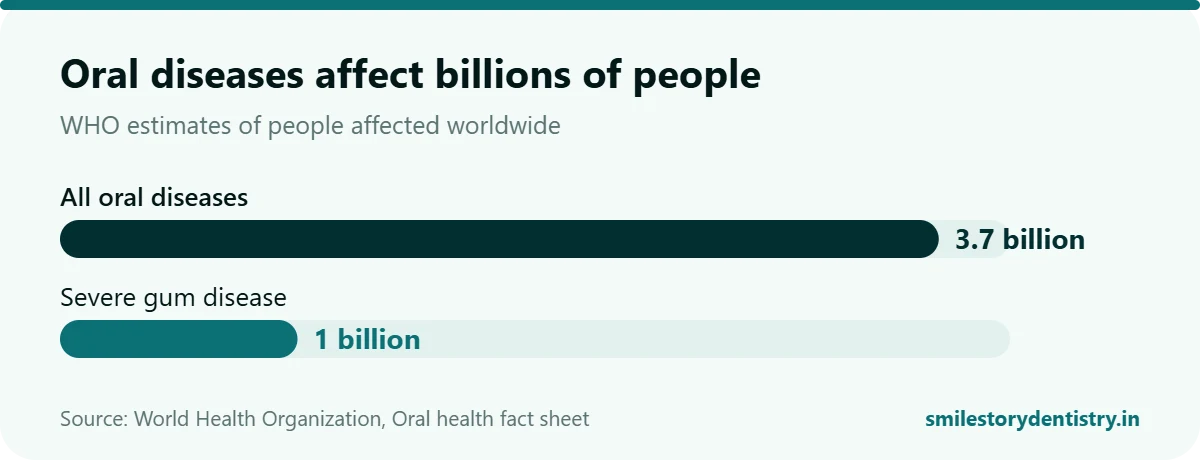
- World Health Organization. Oral health fact sheet
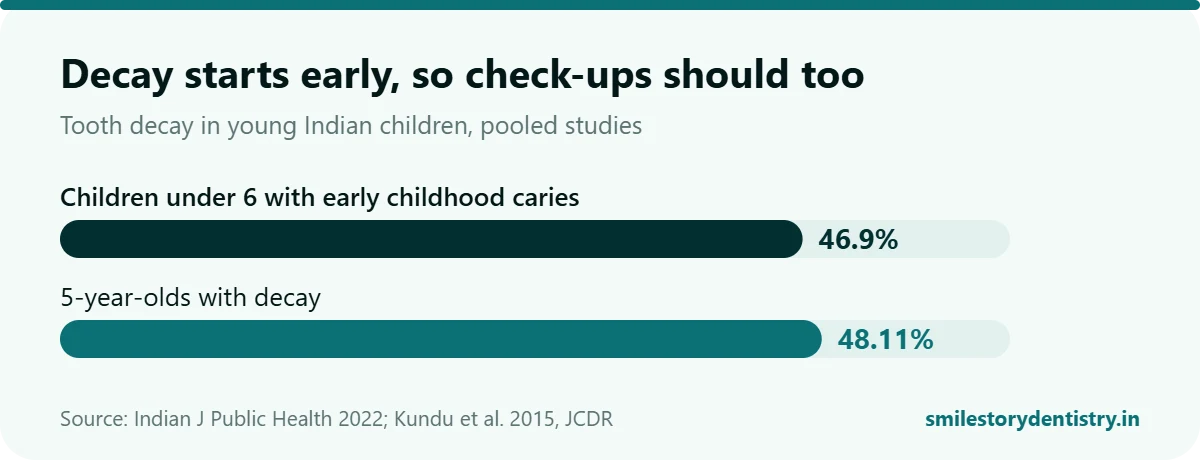
- Kundu H et al. Dental caries scenario among 5, 12 and 15-year-old children in India: a retrospective analysis. JCDR, 2015
- Marinho VCC et al. Fluoride mouthrinses for preventing dental caries in children and adolescents. Cochrane Database of Systematic Reviews, 2016
This guide is for general information and does not replace a dental examination. Every mouth is different, so book a consultation for advice on your own teeth.