Why a root canal tooth needs extra protection
To reach the infected pulp, the dentist removes the decayed part of the tooth and opens up the top of it. Much of the tooth's strength came from the walls and ridges that are now gone. Removing the nerve doesn't weaken it; it's weaker because there's less of it.
Back teeth take the heaviest chewing forces. A tooth with thin walls can split, and a split down the root usually means the tooth has to be removed, undoing the root canal. A crown covers and binds the remaining walls, spreading the bite evenly.
What the research shows
A University of Iowa study followed patients after root canal treatment. After adjusting for tooth type and decay, the teeth that weren't crowned were lost at 6 times the rate of crowned teeth.
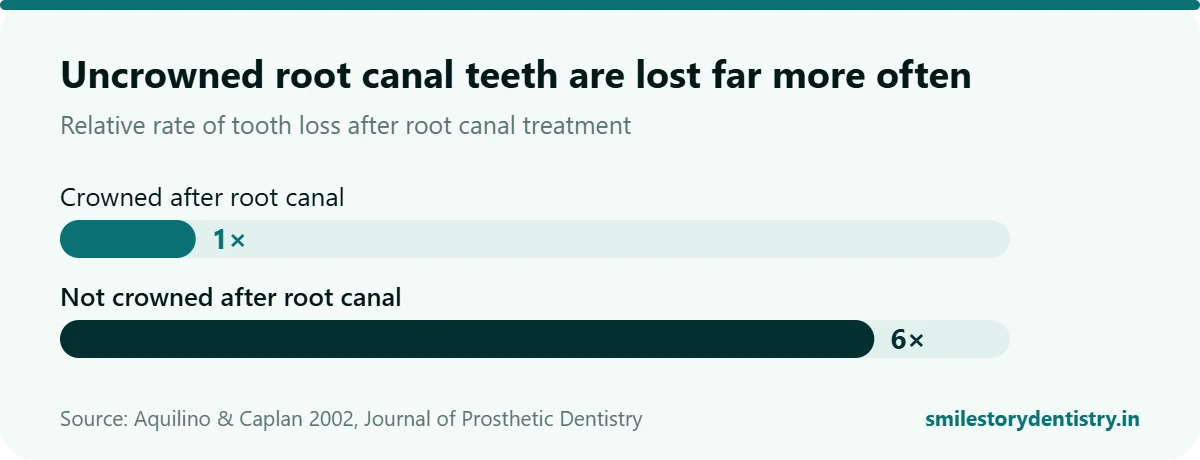
The effect is strongest for molars and premolars. Front teeth that lost little structure often do well with a filling alone.
Crown or filling: what does your tooth need?
| Situation | Usually needs |
|---|---|
| Molar or premolar after root canal | A crown or an onlay that covers the chewing cusps |
| Front tooth with a small access hole | A tooth-coloured filling may be enough |
| Front tooth with large fillings or a crack | A crown, sometimes with a post |
| Very little tooth left above the gum | A post and core to rebuild, then a crown |
| Tooth already had a crown before the root canal | A sealed access filling through the crown, or a new crown if it's damaged |
How soon should you get the crown?
Ideally within 2 to 4 weeks. The temporary filling placed after a root canal isn't designed to last, and saliva can leak past it and re-contaminate the canals. Chewing on a hollowed tooth also risks a crack. Until the crown is fitted, chew on the other side and avoid hard foods like nuts, ice and hard sweets.
Your dentist may wait a little longer if the infection was severe, to check that healing has started.
Which crown material is best?
| Material | Strengths | Best for |
|---|---|---|
| Zirconia | Very strong, tooth-coloured, resists chipping | Molars and people who grind their teeth |
| Lithium disilicate (e.max) | Most natural-looking, strong for its thickness | Front teeth and premolars |
| Porcelain fused to metal | Proven track record | Back teeth where appearance matters less |
| Full metal | Thinnest and toughest | Back molars with little space |
See our crowns and bridges page for what we offer.
What happens when you get a crown
- 1
Build-up
The tooth is rebuilt with a core filling, and a post if very little remains.
- 2
Shaping
A thin layer is shaped from the outside so the crown fits over it.
- 3
Scan or impression
A digital scan or mould records the shape for the lab.
- 4
Temporary crown
Protects the tooth while the permanent crown is made.
- 5
Fitting
The crown is checked for fit, bite and colour, then cemented.
The gap between visits is the riskiest time
Most guides explain why you need a crown. Fewer warn that many root canal teeth crack before the crown is fitted. Protect the tooth in the meantime:
- Book the crown appointment before you leave the root canal visit
- Chew on the other side and skip hard or sticky foods
- If you grind your teeth at night, ask about a temporary guard
- Call if the temporary filling falls out or feels rough, since leakage can re-infect the canals
Crowns after root canals,
answered
Can't find your answer? We're one call away.
Call +91 76039 55135
For some front teeth, yes. For most back teeth, skipping the crown raises the risk of a crack that may cost you the tooth. Ask your dentist how much healthy tooth is left.
The temporary filling can leak, letting bacteria back in, and the weakened tooth can crack. Both can make the root canal fail.
No. A root-canal-treated tooth has no nerve, though the gum around it may be numbed for comfort. Some people feel mild gum tenderness for a day.
With good care, crowns commonly last 10 to 15 years or longer. Regular brushing, cleaning between teeth and check-ups help.
Yes, when the tooth's outer walls are still strong. An onlay covers the chewing cusps but keeps more natural tooth.
Research behind this guide
- Aquilino SA, Caplan DJ. Relationship between crown placement and the survival of endodontically treated teeth. J Prosthet Dent, 2002
- Ng YL, Mann V, Gulabivala K. Tooth survival following non-surgical root canal treatment: a systematic review. International Endodontic Journal, 2010
- Colgate Oral Care Center. When is a root canal without crown protection wise?
- Perio-Implant Advisory. Healing after root canal therapy: when should you get a crown placed?
This guide is for general information and does not replace a dental examination. Every mouth is different, so book a consultation for advice on your own teeth.