What does a root canal actually fix?
Inside every tooth is the pulp: nerves and blood vessels in a narrow channel running down each root. Deep decay, a crack, an old leaking filling or a blow to the tooth can let bacteria reach it. Once the pulp is badly inflamed or infected, it can't heal on its own, and the infection can spread into the jawbone.
A root canal removes that damaged pulp, cleans and shapes the channels, and seals them. The tooth stays in your mouth, usually protected by a crown afterwards. It's the alternative to pulling the tooth out.
9 signs your tooth may need a root canal
| Sign | What it feels or looks like | What it usually means |
|---|---|---|
| Lingering sensitivity | Pain from hot or cold that lasts more than 30 seconds after the drink is gone | The pulp is inflamed and may not recover |
| Pain on biting | Sharp pain when you chew or tap the tooth | Inflammation has reached the tissue at the root tip, or the tooth is cracked |
| Spontaneous throbbing | Toothache that starts on its own or wakes you at night | Irreversible pulpitis |
| Pain that spreads | Ache felt in the jaw, ear or other teeth, hard to pin to one tooth | A deep pulp problem; nerves share pathways |
| Swollen gum | Puffy, tender gum near one tooth | Infection has spread beyond the root |
| Gum pimple | A small bump that leaks pus or a salty taste | A draining abscess |
| Darkened tooth | Grey, brown or black tooth, often after an old injury | The nerve has stopped working |
| Deep decay or a big crack | A visible hole, or a chip that exposes the inner tooth | Bacteria likely reached the pulp |
| Loose tooth with pain | A tooth that moves and hurts | Infection may be dissolving the bone around the root |
You don't need all of these. One clear sign is reason enough to get checked. And some infected teeth cause no pain at all, because the nerve inside has already stopped working; they are found on routine X-rays.
Signs that need same-day care
- Facial swelling, especially if it is spreading toward the eye or under the jaw
- Fever, feeling unwell, or difficulty swallowing or opening your mouth
- Severe pain that painkillers don't touch
- Swelling after a blow to the face or teeth
Spreading facial swelling or trouble breathing or swallowing needs emergency care immediately, at a hospital if your dentist isn't available.
How dentists confirm you need a root canal
- 1
Your history
When the pain started, what triggers it, how long it lasts and whether it wakes you up.
- 2
Cold test
A cold stimulus shows whether the nerve is healthy (brief pain), inflamed (lingering pain) or non-vital (no response).
- 3
Tapping and biting tests
Pain on tapping suggests inflammation at the root tip; a bite stick helps find cracks.
- 4
X-ray
Shows deep decay and dark areas at the root tip where infection has eaten bone.
- 5
Gum probing
Rules out a gum problem or a crack running down the root, which change the treatment plan.
How successful are root canals?
Very. In a systematic review of tooth survival after root canal treatment, about 9 in 10 treated teeth were still in place 4 to 10 years later.
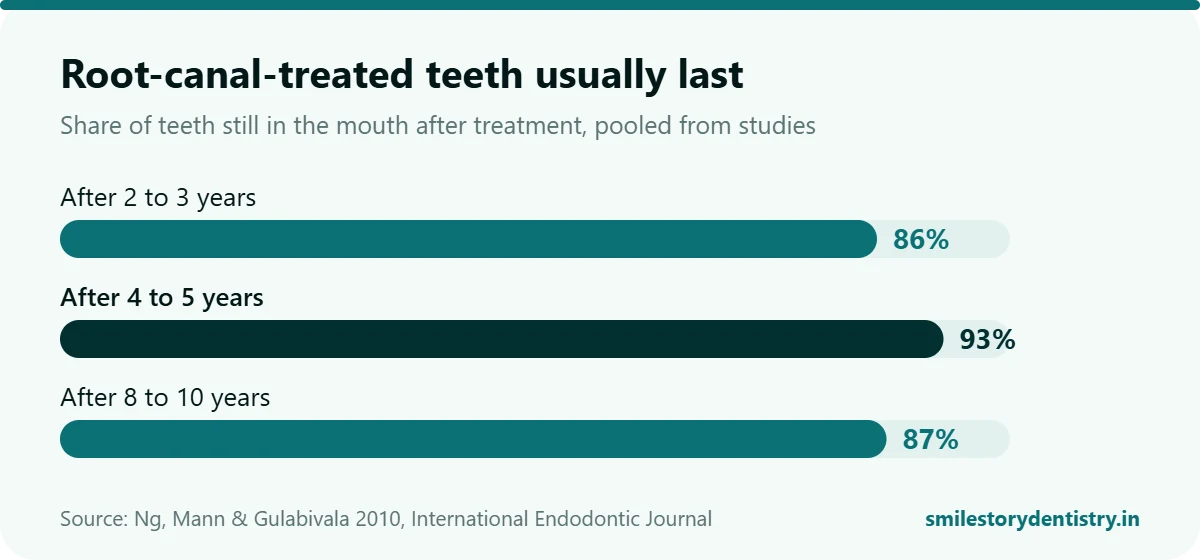
Survival is highest when the tooth gets a proper crown or filling soon after treatment. Read why in our guide to a crown after a root canal.
Common fears, answered
| Myth | Reality |
|---|---|
| Root canals are extremely painful | With modern local anaesthetic the procedure feels similar to a filling. The pain usually comes from the infection, which the treatment relieves. |
| It's better to just pull the tooth | Keeping your natural tooth avoids gaps, shifting teeth and the cost of a bridge or implant. See root canal vs extraction. |
| If the pain stops, the problem is gone | Pain often stops when the nerve stops working, but the infection remains and can spread. |
| Antibiotics can cure it | Antibiotics don't reach inside a non-vital tooth. They may help with spreading infection, but the source must be cleaned out. |
Rate your symptoms before you call
Most guides list symptoms but don't help you decide how fast to act. This simple triage, based on the diagnostic tests above, helps you describe the problem when you book:
- Brief twinge to cold that fades within seconds: likely a sensitive or reversible issue. Book a routine check.
- Cold pain that lingers 30 seconds or more, or pain on biting: book within the week.
- Throbbing that wakes you, a gum pimple, or a dark tooth: book within a day or two.
- Face swelling, fever or difficulty swallowing: same day, or the emergency department.
Root canal signs,
answered
Can't find your answer? We're one call away.
Call +91 76039 55135
Yes. If the nerve has already stopped working, the tooth may not hurt, yet infection can still build at the root tip. These teeth are often found on routine X-rays or when a gum pimple appears.
It depends on the symptoms. Lingering sensitivity should be seen within a week. Swelling, a gum pimple or severe pain should be seen within a day or two, and spreading facial swelling the same day.
Early decay that hasn't reached the pulp can be treated with a filling. Once the pulp is irreversibly inflamed or infected, it can't heal, and a root canal or extraction is needed.
Most are finished in one or two visits. Teeth with severe infection or complex roots may need an extra visit, and a crown is usually fitted afterwards.
If the tooth can be saved, keeping it is usually the first choice. Treated teeth and implants have similar long-term survival, and a root canal avoids surgery and keeps your natural tooth.
Research behind this guide
- Ng YL, Mann V, Gulabivala K. Tooth survival following non-surgical root canal treatment: a systematic review. International Endodontic Journal, 2010
- American Association of Endodontists. Root canal treatment explained
- Aquilino SA, Caplan DJ. Relationship between crown placement and the survival of endodontically treated teeth. J Prosthet Dent, 2002
- Healthline. Do you need a root canal? 7 telltale symptoms
This guide is for general information and does not replace a dental examination. Every mouth is different, so book a consultation for advice on your own teeth.