What each treatment involves
A root canal removes the infected pulp from inside the tooth, disinfects the root canals and seals them. The tooth is then rebuilt, usually with a crown on back teeth. You keep your natural root, which keeps holding the jawbone.
An extraction removes the whole tooth. The pain and infection go with it, but you're left with a gap. Unless the gap is filled with an implant, bridge or denture, neighbouring teeth can tilt into it and the opposite tooth can over-erupt, changing your bite.
Root canal vs extraction compared
| Root canal | Extraction | |
|---|---|---|
| Goal | Save your natural tooth | Remove the problem tooth |
| Visits | 1 to 2, plus a crown visit | 1, plus visits for any replacement |
| Pain during | Numbed, similar to a filling | Numbed, plus pressure during removal |
| Recovery | Mild tenderness for 2 to 3 days | Socket heals over 1 to 2 weeks; bone over months |
| Chewing afterwards | Normal once crowned | Reduced until the gap is replaced |
| Effect on other teeth | None; the tooth keeps its space | Neighbours may drift; bite may change |
| Bone | Root keeps stimulating the jawbone | Bone shrinks where the tooth was |
| Total cost over time | Root canal plus crown | Extraction plus implant, bridge or denture, usually more |
| Best when | Enough healthy tooth and gum support remain | Tooth is cracked through, can't be restored, or gum support is lost |
Which lasts longer?
The research shows both options last well when done properly. A systematic review found about 93% of root-canal-treated teeth survived 4 to 5 years, and a 10-year review of implants found 93% to 96% survival.
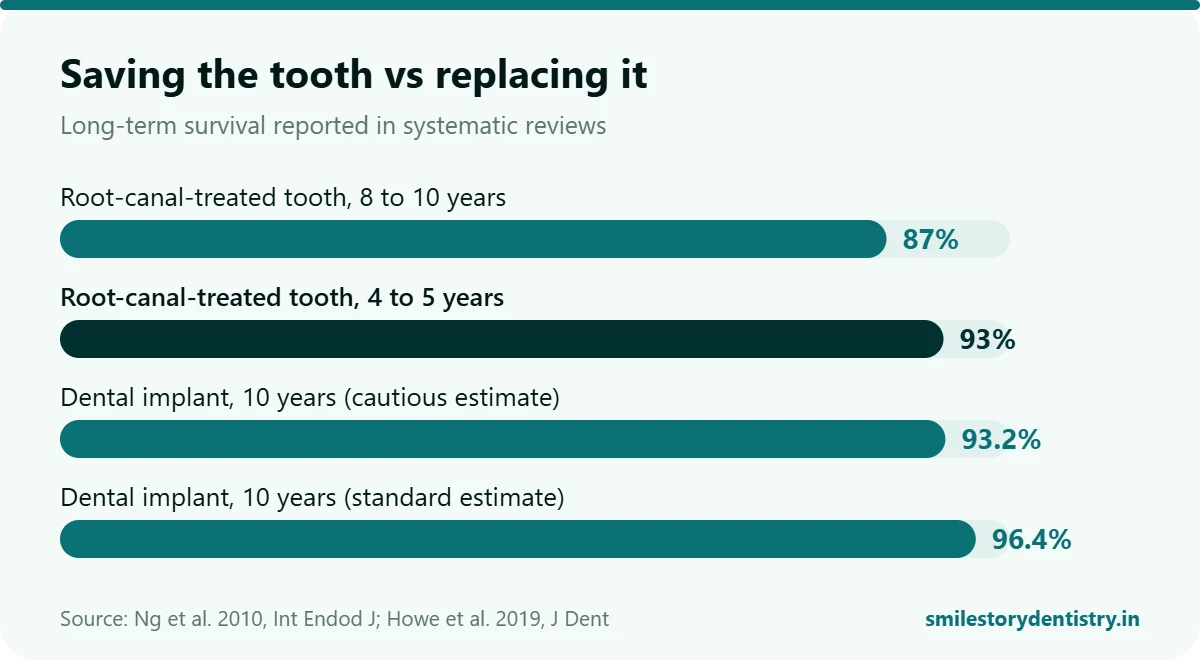
Because outcomes are similar, most dental associations recommend saving the natural tooth when it can be restored, and keeping extraction and implants for teeth that can't be saved.
When pulling the tooth is the better choice
- A crack runs down the root (vertical root fracture)
- So much of the tooth is decayed that it can't hold a crown
- Advanced gum disease has destroyed most of the supporting bone
- A wisdom tooth with no opposing tooth and no chewing role
- A previous root canal has failed and re-treatment isn't predictable
Plan the gap before the tooth comes out
If a back tooth is removed and not replaced, the teeth around it slowly move. Talk through replacement options before the extraction, because some implant plans place bone grafts at the same visit. Options include an implant, a bridge anchored to neighbouring teeth, or a removable partial denture. Learn about dental implants at Smile Story.
Five questions to ask your dentist before deciding
Most comparisons stop at pros and cons. These questions get you an answer specific to your tooth:
- 1
How much healthy tooth is left?
If enough remains to hold a crown, the tooth is usually worth saving.
- 2
How is the gum and bone around it?
A root canal can't fix a tooth whose support is gone.
- 3
Is there a crack, and where does it end?
Cracks that stop above the gum can often be crowned; cracks into the root usually can't.
- 4
What will replacing it involve?
Ask for the full plan and timeline for an implant or bridge, not just the extraction.
- 5
What happens if I wait?
Infection can spread and reduce the chance of saving the tooth, so delays narrow your options.
Root canal or extraction,
answered
Can't find your answer? We're one call away.
Call +91 76039 55135
Both are done under local anaesthetic, so the procedure itself shouldn't hurt. Root canal patients usually have 2 to 3 days of mild tenderness, while an extraction socket can be sore for up to a week.
On the day, usually yes. But replacing the missing tooth with an implant or bridge typically costs more than a root canal and crown, so the total cost of extraction is often higher.
For front and most back teeth, an unreplaced gap lets nearby teeth shift and can affect your bite and chewing. Wisdom teeth are the main exception.
Often, yes. Re-treatment or a minor surgical procedure at the root tip can save many teeth. If the tooth is cracked or can't be restored, extraction becomes the better option.
Most back teeth do, because they take heavy chewing forces. One study found treated teeth without crowns were lost about 6 times more often.
Research behind this guide
- Ng YL, Mann V, Gulabivala K. Tooth survival following non-surgical root canal treatment: a systematic review. International Endodontic Journal, 2010
- Howe MS, Keys W, Richards D. Long-term (10-year) dental implant survival: a systematic review and sensitivity meta-analysis. Journal of Dentistry, 2019
- Aquilino SA, Caplan DJ. Relationship between crown placement and the survival of endodontically treated teeth. J Prosthet Dent, 2002
- Manipal Hospitals. Difference between root canal and tooth extraction
This guide is for general information and does not replace a dental examination. Every mouth is different, so book a consultation for advice on your own teeth.