What counts as crooked teeth?
Dentists use the word malocclusion for any teeth or bite that don't line up ideally. That includes crowding (not enough room), rotated or overlapping teeth, gaps, teeth that stick out, and bite problems such as overbite, underbite, crossbite and open bite.
A little irregularity is normal and harmless. It becomes worth treating when it makes teeth hard to clean, affects chewing or speech, causes uneven wear, or bothers you about your smile.
What causes crooked teeth?
| Cause | How it leads to crooked teeth |
|---|---|
| Genetics | Jaw size and tooth size are inherited separately; large teeth in a small jaw crowd |
| Soft modern diets | Less chewing in childhood may mean less jaw growth, a theory supported by some research |
| Thumb sucking, pacifiers, tongue thrust | Steady pressure pushes teeth and shapes the palate |
| Mouth breathing | Blocked nose or large tonsils change tongue and jaw posture |
| Early loss of milk teeth | Neighbouring teeth drift into the space and block adult teeth |
| Missing or extra teeth | Gaps or crowding from the start |
| Gum disease and ageing | Lower front teeth tend to crowd with age; bone loss lets teeth drift |
| Injury | A knocked tooth can be pushed out of line |
Do crooked teeth affect your health?
- Crowded teeth trap plaque, so cleaning is harder and decay and gum problems are more likely
- Uneven bites can wear or chip some teeth faster
- Teeth that stick out are more likely to be injured (see proclined teeth)
- Some bites strain chewing muscles or affect speech
- Confidence: many people avoid smiling in photos
Ways to straighten crooked teeth
| Option | Best for | Typical time | Visibility |
|---|---|---|---|
| Metal braces | All cases, including complex bites | 12 to 24 months | Visible |
| Ceramic braces | Most cases; tooth-coloured brackets | 12 to 24 months | Less visible |
| Clear aligners | Mild to moderate crowding and gaps | 6 to 18 months | Nearly invisible, removable |
| Lingual braces | Most cases; brackets behind teeth | 12 to 24 months | Hidden |
| Veneers or bonding | Minor rotations or uneven edges in adults | 1 to 3 visits | Changes tooth shape, not position |
| Growth appliances | Children with jaw imbalances | 9 to 18 months | Varies |
| Jaw surgery plus braces | Severe jaw mismatch in adults | About 2 years | Visible during treatment |
See orthodontic treatment at Smile Story for braces and aligners, and smile designing for veneers.
Can adults straighten their teeth?
Yes. Teeth move at any age as long as the gums and bone are healthy, so a gum check comes first. Adult treatment may take a little longer and often uses aligners or tooth-coloured braces for discretion. Many adults combine straightening with whitening or bonding for a complete smile makeover.
The crowding that starts in your 30s
Most guides treat crooked teeth as a childhood issue. But lower front teeth slowly crowd for most of adult life, even in people who never had braces, as the jaws keep changing shape. If you notice your lower front teeth overlapping more than they used to:
- Take a photo now and compare in 6 months, so you know if it's changing
- Ask your dentist to check gum health, since bone loss can speed it up
- Small changes can be corrected quickly with aligners, then held with a retainer
- If you had braces before, wearing your retainer at night prevents this
Crooked teeth,
answered
Can't find your answer? We're one call away.
Call +91 76039 55135
Clear aligners can straighten many mild to moderate cases without brackets. Veneers or bonding can make slightly crooked teeth look straight, but they change the tooth shape, not the position.
There's no single best age. A first check around 7 spots problems early. Most braces start between 11 and 15, but adults can be treated at any age.
They can. Lower front teeth often crowd gradually through adult life, and gum disease can let teeth drift.
For mild to moderate cases, aligners work well if worn 20 to 22 hours a day. Complex bites and large tooth movements are often better with braces.
They can, which is why retainers are essential. Read our guide to retainers after braces.
Research behind this guide
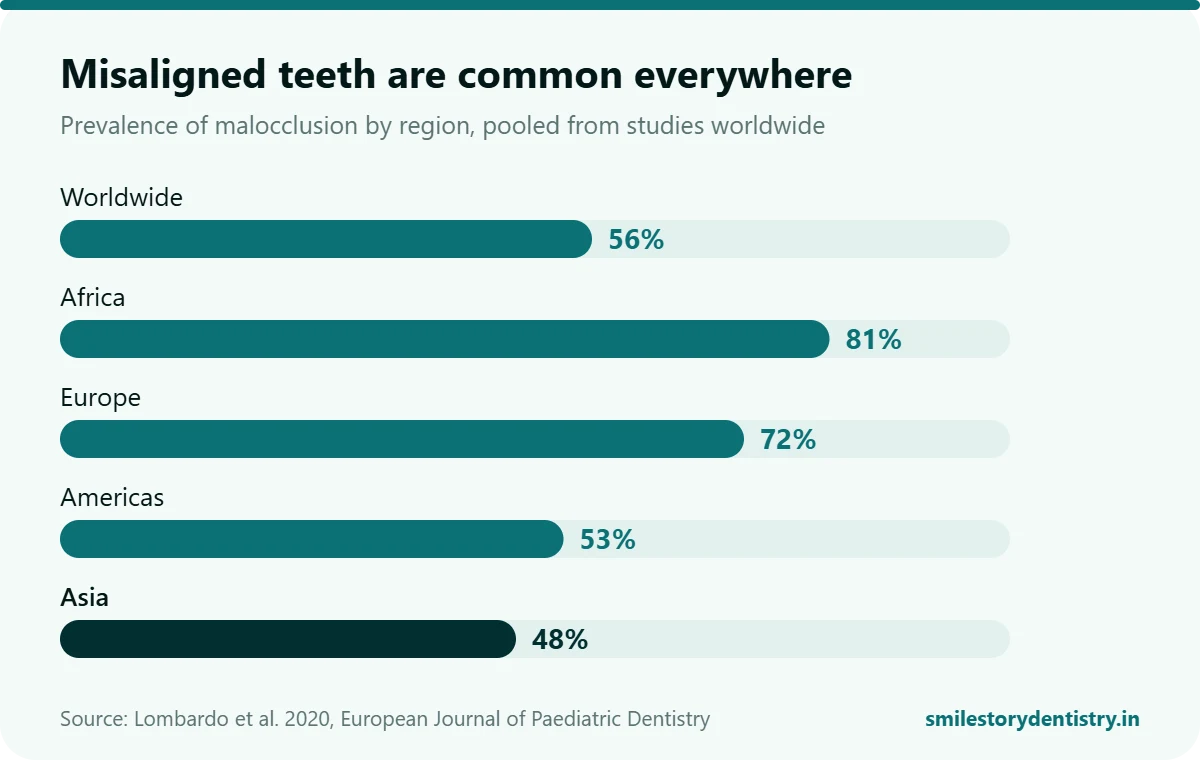
- Lombardo G et al. Worldwide prevalence of malocclusion in the different stages of dentition: a systematic review and meta-analysis. European Journal of Paediatric Dentistry, 2020
- Malocclusion and dental caries experience among 8–9-year-old children in a city of South Indian region. Journal of Education and Health Promotion, 2017
- Cleveland Clinic. Malocclusion (misaligned bite): types and treatment
- Healthline. What causes crooked teeth and how to straighten them
This guide is for general information and does not replace a dental examination. Every mouth is different, so book a consultation for advice on your own teeth.