Do wisdom teeth always need to come out?
No. A wisdom tooth that has come through straight, meets the tooth above or below it, and can be cleaned properly can stay. Removing healthy, symptom-free wisdom teeth "just in case" is no longer routine advice; guidelines such as the UK's NICE recommend removal when there's a clear problem.
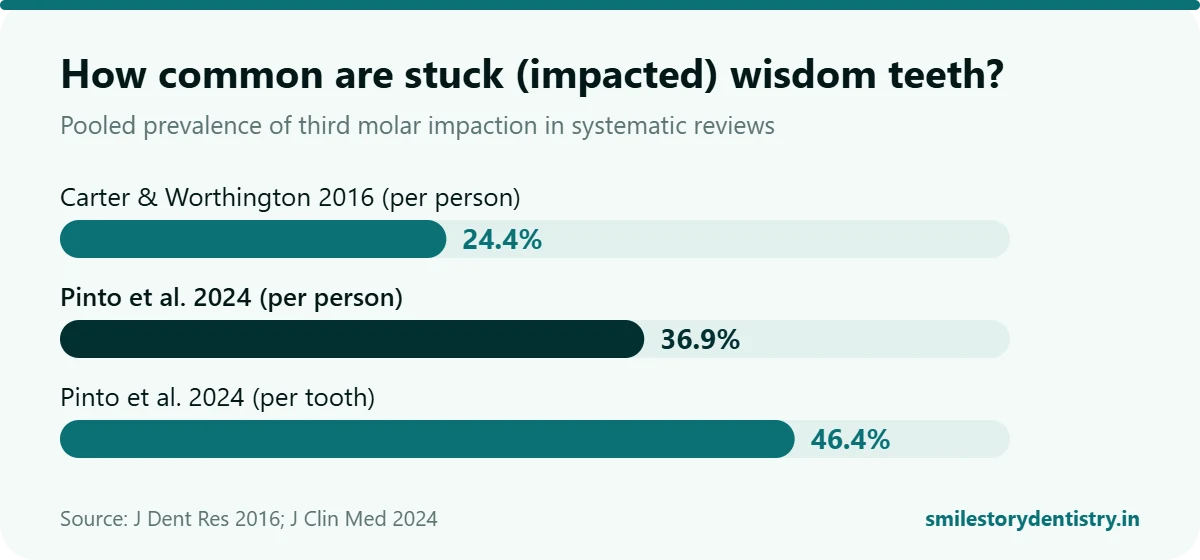
Problems happen when there isn't enough room in the jaw. The tooth may stay buried, come in at an angle, or break through only partly, leaving a flap of gum that traps food and bacteria.
When wisdom tooth removal is recommended
- Repeated gum infections around a half-erupted tooth (pericoronitis)
- Decay in the wisdom tooth, or in the molar in front that can't be cleaned
- Damage to the root of the neighbouring tooth
- A cyst or other change around the tooth seen on X-ray
- Gum disease behind the second molar caused by the wisdom tooth
- Pain from a tooth pushing against bone or other teeth
How the tooth's position changes the procedure
| Position | What it means | Typical removal |
|---|---|---|
| Fully erupted | Through the gum and upright | Simple extraction, often 10 to 20 minutes |
| Partly erupted | Partly covered by gum | May need a small gum flap |
| Soft tissue impaction | Under the gum, not bone | Minor surgery |
| Bony impaction, angled | Tilted into the next tooth (mesioangular) or sideways | Surgical removal, sometimes in sections |
| Deep bony impaction near the nerve | Roots close to the nerve on X-ray | 3D scan (CBCT) first; careful surgical plan |
What happens during removal
- 1
X-ray and planning
A panoramic X-ray shows the tooth's angle and how close the roots sit to the nerve. A 3D scan may be added for deep teeth.
- 2
Numbing
Local anaesthetic numbs the area. You'll feel pressure but not pain.
- 3
Access
For buried teeth, a small flap of gum is opened and a little bone may be removed.
- 4
Removal
The tooth is lifted out whole or in sections to reduce bone removal.
- 5
Closing
The socket is cleaned and a few stitches placed if needed. You bite on gauze to form a clot.
Day-by-day recovery plan
| When | What to expect | What to do |
|---|---|---|
| First 24 hours | Oozing, numbness wearing off | Bite on gauze, cold pack 15 minutes on and off, soft cool food, no rinsing or spitting |
| Days 2 to 3 | Swelling and stiffness peak | Warm salt-water rinses after meals, painkillers as advised, sleep with head raised |
| Days 4 to 7 | Swelling fades, jaw loosens | Gentle brushing near the area, return to soft normal food |
| 1 to 2 weeks | Gum closes over the socket | Stitches removed or dissolve; normal routine |
| Months | Bone fills in the socket | Keep the area clean; food traps reduce over time |
Dry socket and other risks
Dry socket happens when the blood clot is lost before the socket heals, exposing bone. It causes a strong, throbbing pain 2 to 4 days after surgery, often spreading to the ear. It's more common after lower wisdom teeth, in smokers, and in women taking hormonal contraceptives. Your dentist can pack the socket to settle the pain quickly.
Less common risks include infection, temporary numbness of the lip or tongue when roots lie near the nerve, and bleeding. Your dentist will discuss your individual risk using your X-ray.
How to protect the clot: the 72-hour rules
Most guides mention dry socket. These are the specific habits that dislodge the clot, so you can avoid them for the first 3 days:
- No smoking, beedi or chewing tobacco; suction and chemicals both disturb the clot
- No straws, and no forceful spitting or rinsing for 24 hours
- No hot drinks or spicy food on the first day
- Avoid hard, crunchy or tiny foods like rice grains near the socket; eat curd rice, idli, soups and mashed foods
- No heavy exercise for 2 to 3 days, as raised blood pressure restarts bleeding
- Call us if pain gets worse after day 3 instead of better
Wisdom teeth,
answered
Can't find your answer? We're one call away.
Call +91 76039 55135
The procedure is done under local anaesthetic, so you'll feel pressure but not pain. Soreness and swelling afterwards are normal for a few days and are usually controlled with painkillers your dentist recommends.
When removal is needed, it tends to be easier in the late teens and twenties, before the roots are fully formed and the bone becomes denser. Healthy, well-positioned wisdom teeth don't need to be removed at any age.
Soft, cool foods for the first day or two: curd, curd rice, idli, mashed vegetables, soups that aren't hot, and smoothies without a straw. Avoid hard, spicy and crunchy foods until the socket heals.
Most people are back to normal activities in 3 to 5 days. The gum closes in 1 to 2 weeks, and the bone fills in over a few months.
Only if they all have problems. Many people only need one or two removed. Your dentist will advise based on X-rays and symptoms.
Research behind this guide
- Carter K, Worthington S. Predictors of third molar impaction: a systematic review and meta-analysis. Journal of Dental Research, 2016
- Pinto AC et al. Worldwide prevalence and demographic predictors of impacted third molars: systematic review with meta-analysis. Journal of Clinical Medicine, 2024
- NICE. Guidance on the extraction of wisdom teeth (TA1)
- Mayo Clinic. Impacted wisdom teeth: symptoms and causes
This guide is for general information and does not replace a dental examination. Every mouth is different, so book a consultation for advice on your own teeth.