Surface stains vs stains inside the tooth
Extrinsic stains sit on the outer enamel. They come from what touches your teeth: tea, coffee, turmeric-rich curries, paan, tobacco and some mouthwashes. They usually respond to cleaning and whitening.
Intrinsic stains are inside the tooth, in the enamel or dentine. They come from tooth development, injury, medicines, ageing or excess fluoride while teeth were forming. Whitening helps some of these; others need bonding, veneers or crowns. Many people have both.
What each colour usually means
| Colour or pattern | Likely cause | Usual fix |
|---|---|---|
| Overall yellowing | Age (enamel thins, yellow dentine shows), surface stains | Cleaning, then whitening |
| Brown or black lines at the gumline | Tea, coffee, tobacco, paan, iron supplements | Scaling and polishing |
| Chalky white spots | Mild fluorosis, or early decay (often around old braces) | Remineralising care, micro-abrasion or resin infiltration |
| Brown mottling or pitting | Moderate to severe fluorosis | Micro-abrasion, bonding or veneers |
| Grey or dark single tooth | Injury, or a nerve that has stopped working | Check vitality; root canal and internal bleaching or a crown |
| Grey-blue bands across teeth | Tetracycline antibiotics taken in childhood | Long whitening courses, veneers or crowns |
| Black spot in a groove | Stain or decay | Exam and X-ray; filling if decayed |
| Green or orange near the gums (children) | Bacterial stain from plaque | Professional cleaning, better brushing |
Fluoride, water and teeth in Madurai
Fluoride at the right level protects teeth from decay. Too much while the teeth are forming, usually before age 8, causes dental fluorosis: white flecks in mild cases, brown mottling and pitting in severe ones. Studies list Madurai among the Tamil Nadu districts where fluorosis is endemic, linked to naturally high fluoride in groundwater.
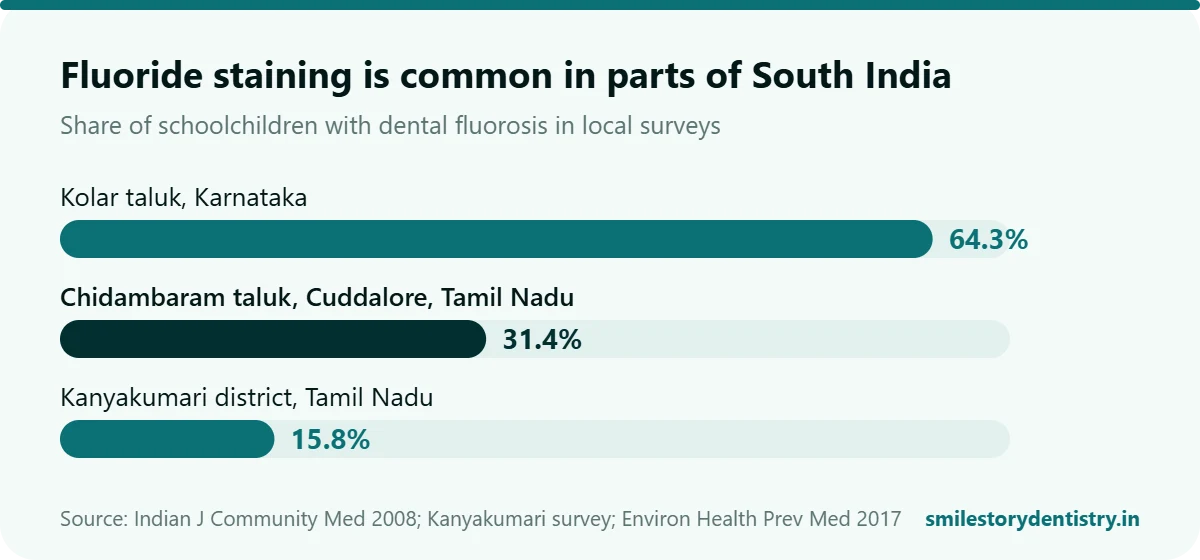
Fluorosis isn't decay and doesn't spread. It's a cosmetic issue, and it can be treated.
How to prevent stains
- Rinse with water after tea, coffee and paan, and wait 30 minutes before brushing after acidic drinks
- Brush twice a day with fluoride toothpaste and get a professional cleaning every 6 months
- Quit tobacco and areca nut; they stain deeply and raise the risk of mouth cancer
- Use a smear of toothpaste for children under 3 and a pea-sized amount for 3 to 6 year olds
- In high-fluoride areas, ask about testing your borewell water, especially for young children
- Get any knocked or darkening tooth checked early
Treatments compared
| Treatment | Works best for | Notes |
|---|---|---|
| Scaling and polishing | Surface stains, tartar | Quick; often the first step |
| In-clinic whitening | Yellowing, mild intrinsic stains | Visible change in one visit |
| Take-home whitening trays | Yellowing, tetracycline (long courses) | Gradual; dentist-made trays |
| Micro-abrasion and resin infiltration | White spots, mild fluorosis | Removes or masks a thin layer |
| Composite bonding | Small stains, pits | Tooth-coloured resin, single visit |
| Veneers or crowns | Severe fluorosis, tetracycline, dark teeth | Most predictable colour change |
Why one dark tooth is different
Most stain guides talk about whole-smile yellowing. A single tooth turning grey or dark, often years after a fall or sports knock, is different: it usually means the nerve inside has stopped working. It may not hurt, but an infection can develop silently at the root tip. Whitening toothpaste won't help.
Get it checked with a vitality test and an X-ray. If it needs a root canal, the tooth can then be whitened from the inside, often matching its neighbours without a crown.
Tooth discolouration,
answered
Can't find your answer? We're one call away.
Call +91 76039 55135
Brushing removes daily plaque but not deep stains or natural colour. As enamel thins with age, the yellower dentine underneath shows through. Professional cleaning and whitening can help.
Yes. Mild white spots respond to micro-abrasion or resin infiltration. Brown mottling may need whitening plus bonding, or veneers for severe cases.
It can remove some surface stains with mild abrasives, but it doesn't change the tooth's inner colour. For a real shade change, dentist-supervised whitening works better.
A single grey tooth often means the nerve has stopped working, usually after an old injury. It should be checked with an X-ray even if it doesn't hurt.
Dentist-supervised whitening is safe for most people. Temporary sensitivity is common. It's not suitable during pregnancy, and doesn't change the colour of fillings or crowns.
Research behind this guide
- Saravanan S et al. Prevalence of dental fluorosis among primary school children in rural areas of Chidambaram taluk, Cuddalore district, Tamil Nadu. Indian J Community Med, 2008
- India Water Portal. Prevalence of dental fluorosis and associated risk factors in schoolchildren of Kanyakumari
- Dental fluorosis among adolescents in Kolar taluk, Karnataka. Environmental Health and Preventive Medicine, 2017
- Indian Dental Association. Teeth discolouration
- Watts A, Addy M. Tooth discolouration and staining: a review of the literature. British Dental Journal, 2001
This guide is for general information and does not replace a dental examination. Every mouth is different, so book a consultation for advice on your own teeth.