What is a fixed retainer?
It's a thin, often braided wire shaped to the back of your front teeth and bonded to each tooth with tooth-coloured composite. It's usually placed on the lower front 4 to 6 teeth, sometimes the upper ones too, on the day braces come off. It can't be seen when you smile.
When a fixed retainer is recommended
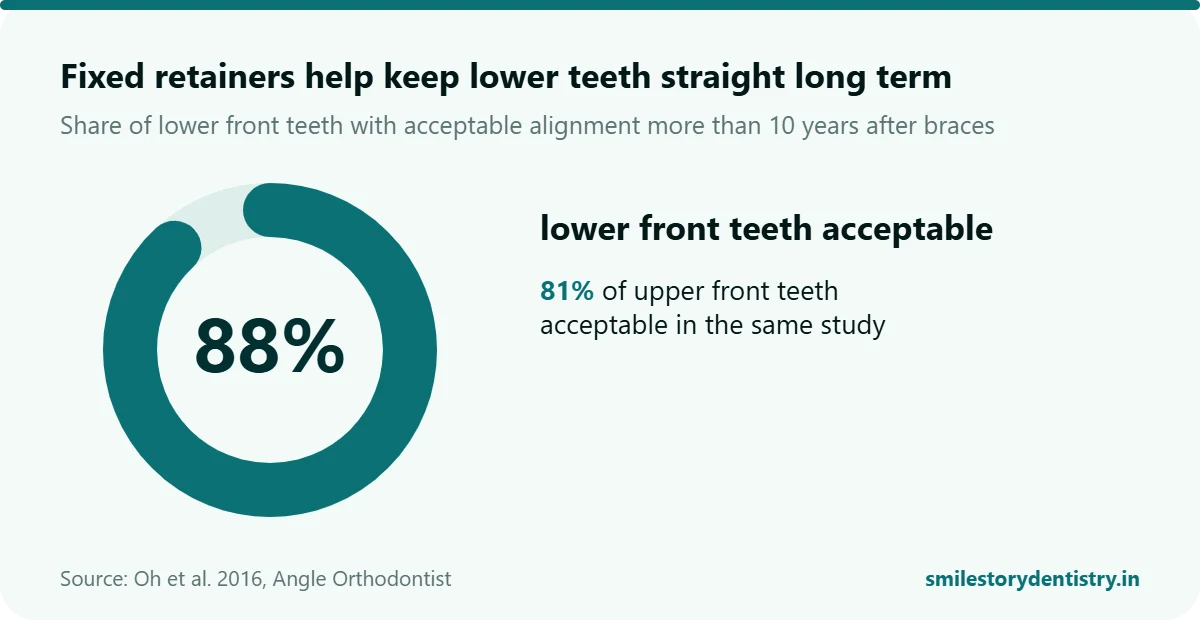
- Lower front teeth that were very crowded before treatment
- Closed gaps between front teeth, which tend to reopen
- Teeth that were badly rotated
- Patients who may not wear a removable retainer reliably
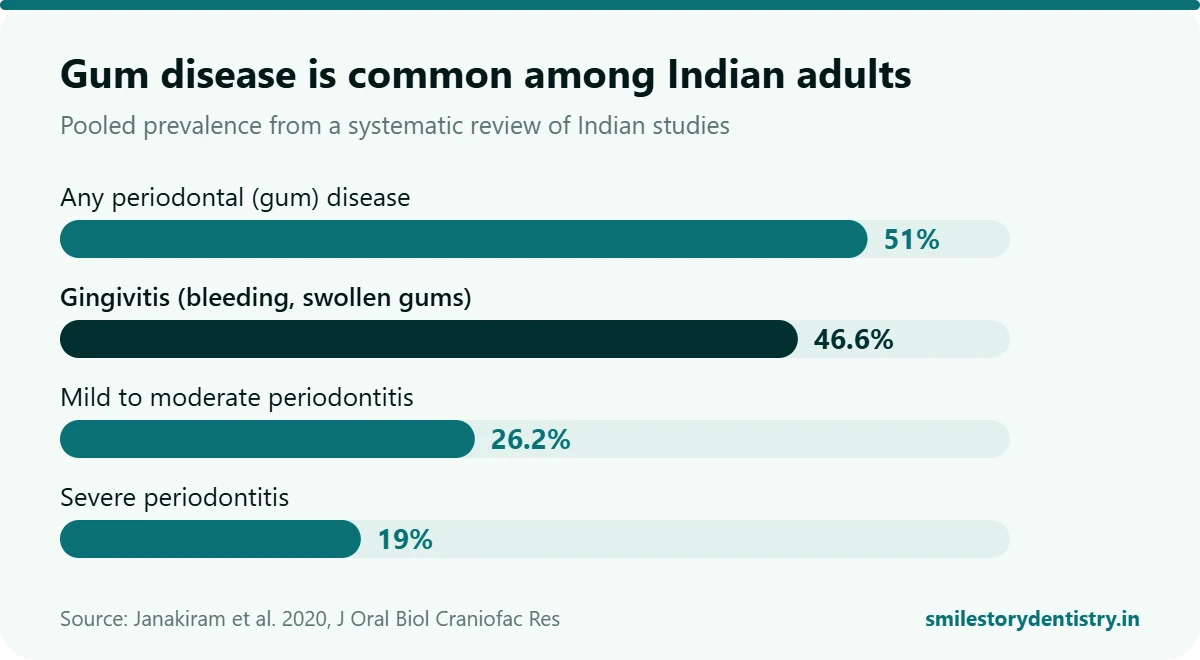
- Teeth weakened by gum disease that need splinting
Fixed vs removable retainer
| Fixed retainer | Removable retainer | |
|---|---|---|
| Works | 24 hours, automatically | Only when worn |
| Visible | No | Clear ones barely; Hawley wire yes |
| Cleaning | Needs threader floss or interdental brush | Easy; take it out |
| Risk | Wire can debond or break, sometimes unnoticed | Can be lost or forgotten |
| Lifespan | Many years if it stays bonded | Often 1 to 3 years |
How to clean around a fixed retainer
- 1
Brush at an angle
Tilt the brush to reach behind the wire, top and bottom edges.
- 2
Floss under the wire
Use a floss threader or super floss to pass floss under the wire between each pair of teeth.
- 3
Try an interdental brush
Small brushes slip under the wire faster than floss for many people.
- 4
Get regular cleanings
Tartar builds up behind lower front teeth quickly; a scaling every 6 months helps.
What if your fixed retainer breaks or comes loose?
A systematic review of 21 studies found that no wire type is clearly better, and that failures are most common in the first months after bonding, so frequent checks in the first 6 months are advised. Our guide to retainers after braces compares fixed and removable types.
If one bond comes loose, the tooth beside it can start moving within weeks, even if the rest of the wire looks fine. Run your tongue along the wire each week. If it feels loose, sharp or a tooth seems to be moving, book a repair rather than waiting for your next check-up. Keep wearing any removable retainer you have in the meantime.
The 10-second weekly retainer check
Fixed retainers fail quietly. Most guides say "see your dentist if it breaks", but a loose bond often isn't obvious. Make this part of brushing once a week:
- Look in a mirror at the back of the front teeth: is the wire touching every tooth?
- Press gently on each tooth with a finger: does any move separately from the others?
- Run floss under the wire: does it snag on a sharp edge?
- Check the front: have any small gaps appeared, or a tooth started to twist?
Fixed retainers,
answered
Can't find your answer? We're one call away.
Call +91 76039 55135
Many stay for years, sometimes decades, as long as gums stay healthy and the bonds hold. Your orthodontist can remove it if needed and switch you to a removable retainer.
No. It may feel strange to your tongue for a few days. Placing it is painless; the teeth are cleaned and the wire is glued on.
It makes cleaning harder, so plaque and tartar can build up behind the teeth. With daily cleaning under the wire and regular scaling, gums usually stay healthy.
No. It's bonded to the teeth and must be removed by a dentist to avoid damaging enamel.
Usually, yes. A single loose bond can often be re-glued in one short visit. If the wire is bent or teeth have moved, it may need replacing.
Research behind this guide
- Jedliński M et al. What causes failure of fixed orthodontic retention? Systematic review and meta-analysis of clinical studies. Head & Face Medicine, 2021
- Oh H et al. Evaluation of posttreatment stability after orthodontic treatment in the mixed and permanent dentitions. Angle Orthodontist, 2016
- India Dental World. What is a retainer?
This guide is for general information and does not replace a dental examination. Every mouth is different, so book a consultation for advice on your own teeth.