What is a mouth ulcer?
A mouth ulcer is a small, painful break in the lining of the mouth. The common type, called an aphthous ulcer or canker sore, is round or oval, white or yellow in the centre with a red border, and stings with salty, sour or spicy food. They usually appear on the inner cheeks, lips, tongue or floor of the mouth.
They're not contagious. Cold sores, which form outside the lips and are caused by a virus, are a different condition. If ulcers keep coming back in busy weeks, read how stress affects your mouth.
Types of aphthous ulcers
| Type | Size | Healing time |
|---|---|---|
| Minor (most common) | Under 1 cm, often a few at a time | 7 to 14 days, no scar |
| Major | Over 1 cm, deeper | Weeks, may scar |
| Herpetiform | Many pinhead ulcers that merge | 1 to 2 weeks |
What causes mouth ulcers?
| Trigger | Example |
|---|---|
| Injury | Biting your cheek, a sharp tooth, braces wire, rough brushing, a hot drink |
| Stress and poor sleep | Ulcers during exams or work deadlines |
| Nutritional gaps | Low iron, vitamin B12 or folate |
| Hormonal changes | Around periods in some women |
| Food sensitivities | Very spicy or acidic foods, some people react to certain foods |
| Toothpaste ingredients | Sodium lauryl sulfate (SLS) in some pastes |
| Medical conditions | Coeliac disease, inflammatory bowel disease, Behçet's disease, low immunity |
| Medicines | Some painkillers, beta blockers and other drugs |
How to heal a mouth ulcer faster
- 1
Protect it
Avoid spicy, salty, sour and crunchy foods until it heals. Use a soft toothbrush.
- 2
Rinse
Warm salt-water rinses or an alcohol-free antiseptic mouthwash keep the area clean.
- 3
Numb or coat it
Pharmacy gels with a local anaesthetic, or protective pastes, ease pain while eating.
- 4
Fix the trigger
Have a sharp tooth or broken filling smoothed; switch to an SLS-free toothpaste if ulcers keep returning.
- 5
Check your levels
For frequent ulcers, ask your doctor about blood tests for iron, B12 and folate.
When a mouth ulcer needs checking
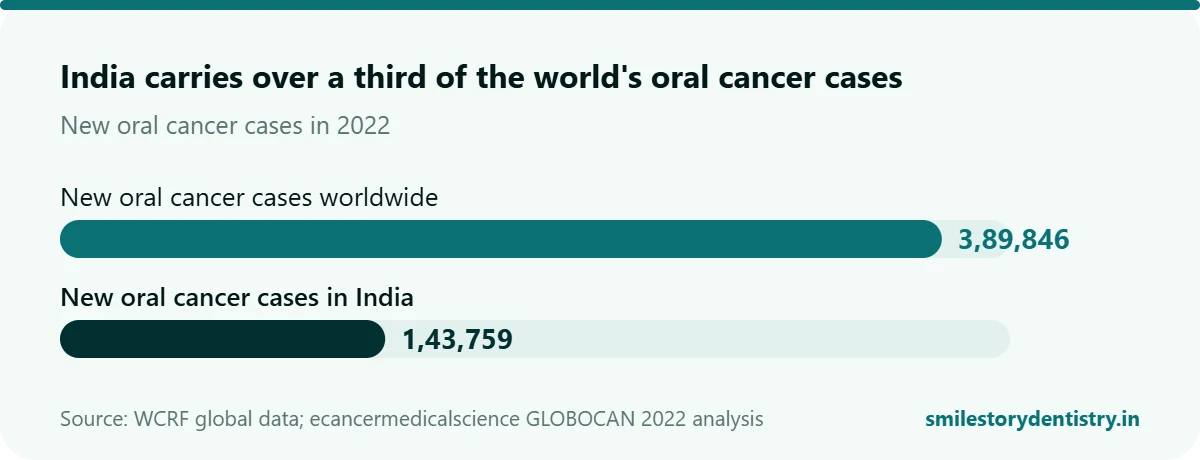
Health services including the NHS advise getting any mouth ulcer that hasn't healed in 3 weeks examined. In India this matters more than most places, because of how common oral cancer is here.
- An ulcer that lasts longer than 3 weeks
- A painless ulcer, especially with hard, raised edges
- A red or white patch that doesn't rub off
- A lump, or an ulcer that bleeds easily
- Numbness in the tongue or lip, or a loose tooth without gum disease
- Ulcers along with fever, weight loss or ulcers elsewhere in the body
If you use tobacco or areca nut, check monthly
Most guides treat ulcers as a nuisance. For anyone who uses gutka, pan, supari, khaini, beedi or cigarettes, a sore that won't heal is a reason to act fast. Early mouth cancer is often painless, so pain isn't a reliable warning.
Once a month, in good light, look and feel inside your mouth: cheeks, gums, the sides and underside of the tongue, the floor of the mouth and the roof. Look for any patch, ulcer or lump that's new. If something is still there after 2 to 3 weeks, book an examination. Quitting tobacco and areca nut is the single biggest way to lower your risk.
Mouth ulcers,
answered
Can't find your answer? We're one call away.
Call +91 76039 55135
Recurrent ulcers are often linked to stress, minor injuries, certain toothpastes, hormonal changes or low iron, B12 or folate. If you get them often, a dentist or doctor can look for a trigger and order blood tests.
Low vitamin B12, folate and iron are the most common nutritional links. Don't start high-dose supplements without a test, as the cause may be something else.
This is a popular belief, but there's no medical evidence for "body heat". Spicy food can irritate an existing ulcer, and dehydration or stress may play a part.
Minor ulcers usually heal in 7 to 14 days. Larger ulcers can take several weeks. Any ulcer lasting more than 3 weeks should be examined.
Most aren't. But a sore that doesn't heal in 3 weeks, especially if painless, hard or in a tobacco user, should be checked to rule out cancer.
Research behind this guide
- NHS. Mouth ulcers
- Oral cancer burden in India: a GLOBOCAN 2022 analysis. ecancermedicalscience
- Cleveland Clinic. Mouth ulcers: types, causes and treatment
- Scully C, Shotts R. Mouth ulcers and other causes of orofacial soreness and pain. BMJ, 2000
- NHS inform. Mouth ulcer
- World Cancer Research Fund. Mouth and oral cancer statistics
This guide is for general information and does not replace a dental examination. Every mouth is different, so book a consultation for advice on your own teeth.