What is an impacted tooth?
A tooth is impacted when it can't come into its normal position by the expected age. It may be completely buried in bone, sitting under the gum, or partly through at an angle. Often there's simply not enough space in the jaw; other times the tooth develops at the wrong angle or something blocks its path, such as a baby tooth that didn't fall out or an extra tooth.
Some impacted teeth never cause trouble. Others damage nearby teeth, trap food, or form cysts, so they're worth monitoring with X-rays even when they don't hurt.
Teeth that commonly get impacted
| Tooth | Usual age it's noticed | Typical approach |
|---|---|---|
| Lower wisdom teeth | Late teens to twenties | Monitor if healthy; remove if causing problems |
| Upper wisdom teeth | Late teens to twenties | Usually easier to remove when needed |
| Upper canines (eye teeth) | Around 10 to 13 | Early baby tooth removal, or surgical exposure with braces |
| Premolars | Around 11 to 13 | Space creation with braces, or removal |
| Extra teeth (supernumerary) | Childhood | Removal if blocking other teeth |
Signs of an impacted tooth
- No symptoms at all, found on a routine X-ray
- Swollen, tender gum at the back of the mouth
- Pain or pressure in the jaw, sometimes spreading to the ear
- Bad breath or a bad taste from a partly erupted tooth
- A baby tooth that stays long after age 12 or 13
- A gap where an adult tooth should have appeared
Why impacted teeth sometimes need treatment
- Gum infection around a partly erupted tooth (pericoronitis)
- Decay in the impacted tooth or the one beside it
- Root damage to a neighbouring tooth
- Cysts that slowly enlarge in the jaw
- Crowding or shifting of other teeth
Treatment options
- 1
Watch and wait
For healthy, symptom-free teeth: regular X-rays to check nothing is changing.
- 2
Make space
Braces or removing a baby tooth can give an adult tooth room to come through on its own.
- 3
Expose and guide
For canines: the tooth is uncovered surgically and a small bracket attached so braces can pull it into place over months.
- 4
Remove
For wisdom teeth or teeth that can't be saved: surgical extraction, planned with X-rays or a 3D scan.
Why age 10 to 12 matters for eye teeth
Most guides focus on wisdom teeth, but an impacted upper canine is the one parents can do the most about. The canine is key to the smile and to how the teeth guide the bite. When a dentist spots it early on X-ray, removing the baby canine at the right time can let the adult tooth correct its path without surgery in many children.
If your child is 10 or older and the baby canines are still firm, or you can't feel the bulge of the adult canine above them, ask for a check. Our children's dentistry and orthodontic teams work together on these cases.
Impacted teeth,
answered
Can't find your answer? We're one call away.
Call +91 76039 55135
No. Healthy impacted teeth that cause no symptoms or damage can be monitored. Removal is advised when they cause infection, decay, cysts or damage to nearby teeth.
It's done under local anaesthetic, so you'll feel pressure but not pain. Expect a few days of swelling and soreness afterwards, managed with painkillers.
Sometimes, if space is created early, especially in children. Wisdom teeth that are deeply angled usually won't.
An X-ray is the only reliable way. A dentist may suspect it if a tooth is missing from the expected spot or the gum at the back is swollen.
It's an upper eye tooth trapped in the bone, often above the baby canine. It's usually treated with braces and a minor procedure to guide it into place.
Research behind this guide
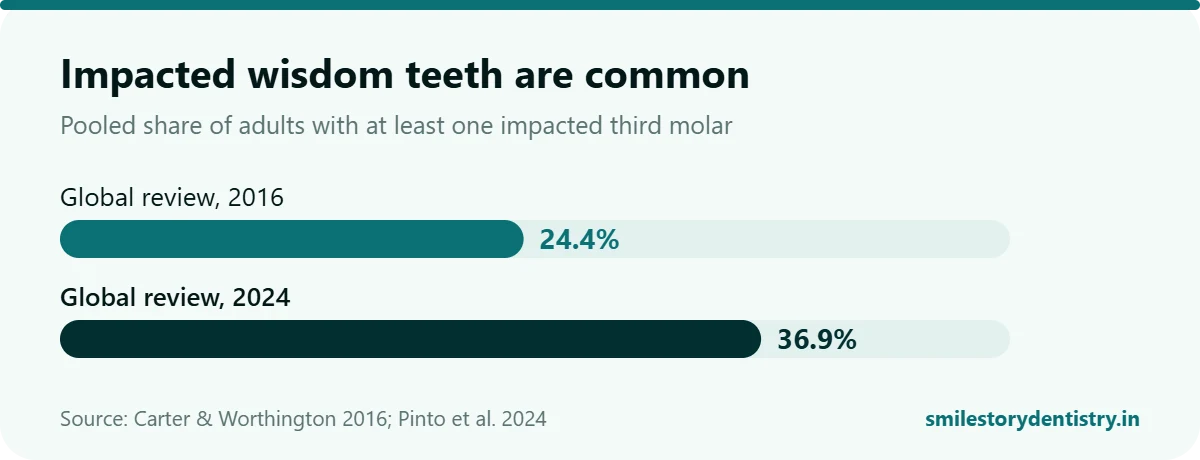
- Carter K, Worthington S. Predictors of third molar impaction: a systematic review and meta-analysis. Journal of Dental Research, 2016
- Pinto AC et al. Worldwide prevalence and demographic predictors of impacted third molars. Journal of Clinical Medicine, 2024
- American Association of Orthodontists. What is an impacted tooth and how is it treated?
- Cleveland Clinic. Impacted tooth: types, symptoms and treatment
- MedlinePlus. Impacted tooth
This guide is for general information and does not replace a dental examination. Every mouth is different, so book a consultation for advice on your own teeth.