Is mouthwash necessary?
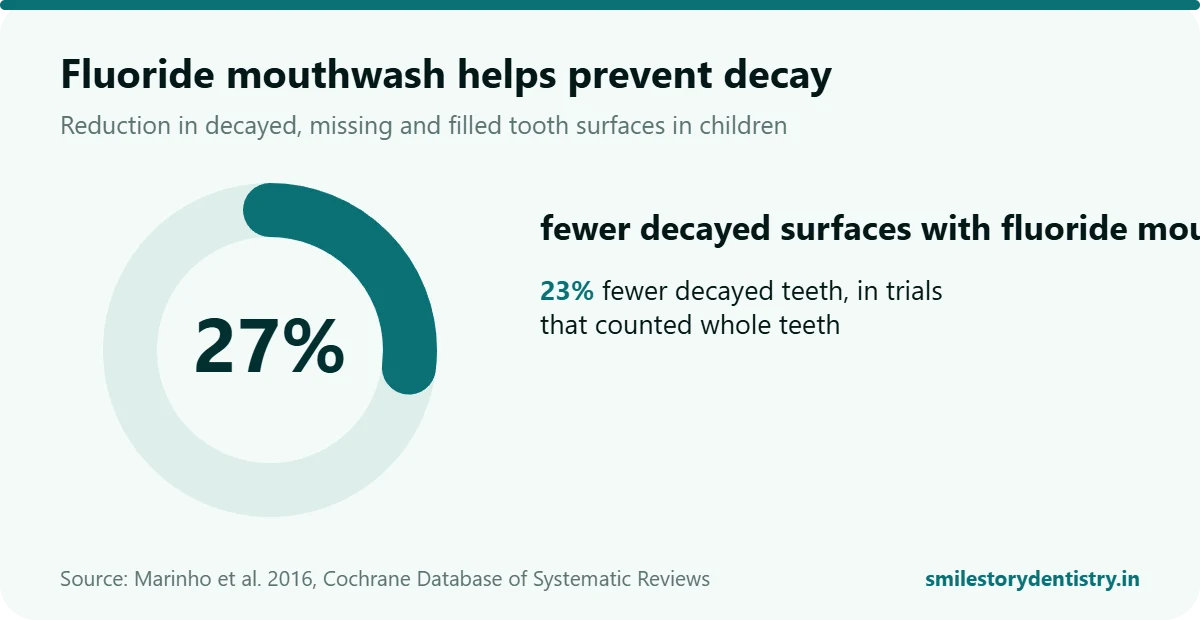
Not for everyone. Brushing twice a day with fluoride toothpaste and cleaning between your teeth do most of the work. Mouthwash is an extra that helps specific people: those prone to cavities, people with braces, gum problems or dry mouth, and for short periods after gum treatment or surgery.
Types of mouthwash and what they do
| Type | What it's for | Notes |
|---|---|---|
| Fluoride | Preventing cavities | Use at a different time from brushing |
| Chlorhexidine | Short-term gum control after treatment or surgery | Prescription course; can stain teeth and change taste with long use |
| Cetylpyridinium chloride (CPC) or essential oils | Reducing plaque and gingivitis | Everyday options; follow the label |
| Alcohol-free | Dry mouth, sensitive mouths | Gentler; choose if alcohol stings |
| Cosmetic | Fresh breath | Masks odour but doesn't treat its cause |
How to use mouthwash, step by step
- 1
Pick the right time
Use it at a separate time from brushing, such as after lunch, so you don't wash off toothpaste fluoride.
- 2
Measure the dose
Usually 10 to 20 ml, as on the label.
- 3
Swish and gargle
Move it around all teeth for 30 to 60 seconds, or as directed.
- 4
Spit, don't swallow
And don't rinse with water afterwards.
- 5
Wait to eat or drink
About 30 minutes, so it can keep working.
Mouthwash mistakes and cautions
- Using it straight after brushing, which dilutes the fluoride from your toothpaste
- Using it instead of brushing or flossing
- Using chlorhexidine for months without advice, which can stain teeth
- Giving mouthwash to children under 6, who may swallow it
- Covering up bad breath that keeps coming back, which can be a sign of gum disease or a decayed tooth
Chlorhexidine and tea: a staining combination
If your dentist prescribes chlorhexidine after a cleaning or gum treatment, be aware that it can stain teeth brown, especially when combined with tea or coffee. A laboratory study found chlorhexidine stains teeth in the presence of black tea.
During the course, wait at least 30 minutes after rinsing before having tea or coffee, and stop when the course ends. Any staining usually polishes off at your next cleaning. More in our teeth discolouration guide.
Mouthwash,
answered
Can't find your answer? We're one call away.
Call +91 76039 55135
Ideally at a different time, such as after lunch. Rinsing right after brushing washes away the concentrated fluoride your toothpaste leaves behind.
No. Mouthwash can't remove plaque stuck to teeth or between them. Brushing and cleaning between teeth are essential.
It's gentler and better for dry or sensitive mouths. Choose based on the active ingredient you need, such as fluoride for cavities.
Most over-the-counter fluoride and CPC mouthwashes are designed for daily use. Chlorhexidine is usually for short courses only.
It masks it for a few hours. Lasting bad breath usually comes from the tongue, gum disease or a decayed tooth, which need treating.
Research behind this guide
- Marinho VCC et al. Fluoride mouthrinses for preventing dental caries in children and adolescents. Cochrane Database of Systematic Reviews, 2016
- James P et al. Chlorhexidine mouthrinse as an adjunctive treatment for gingival health. Cochrane Database of Systematic Reviews, 2017
- Carey CM et al. Effect of temperature on tooth staining by 0.12% chlorhexidine gluconate. Frontiers in Dental Medicine, 2021
This guide is for general information and does not replace a dental examination. Every mouth is different, so book a consultation for advice on your own teeth.