Why cleaning matters more with braces
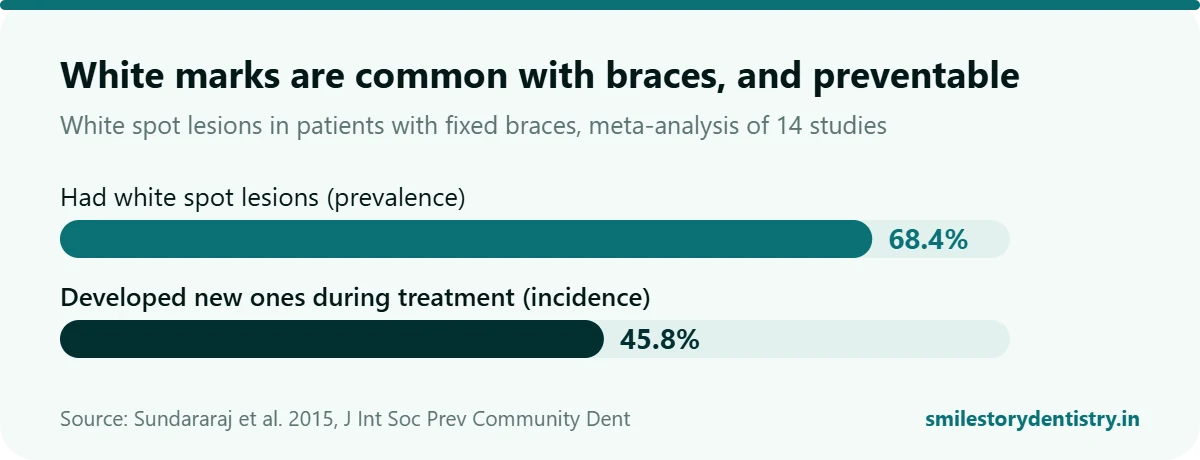
Plaque that sits around a bracket for weeks starts dissolving minerals from the enamel. The result is a chalky white mark, an early stage of decay called a white spot lesion. Once the braces come off, the outline of every bracket can be visible. Gums can also swell and bleed, which slows tooth movement.
Tools that make it easier
| Tool | What it's for |
|---|---|
| Soft or orthodontic toothbrush (V-shaped bristles) | Cleans around and under brackets |
| Fluoride toothpaste | Strengthens enamel against white spots |
| Interdental brush (proxy brush) | Cleans under the wire and between brackets |
| Floss threader or orthodontic floss | Gets floss under the wire to clean between teeth |
| Water flosser | Flushes food from around brackets; helpful, but doesn't replace brushing |
| Fluoride mouthwash | Extra protection, used at a different time from brushing |
| Orthodontic wax | Covers brackets that rub your cheeks |
Step-by-step cleaning routine
- 1
Rinse
Swish water to loosen food. Remove elastics if your orthodontist allows.
- 2
Brush above the brackets
Angle the brush down toward the bracket and gumline, small circles on each tooth.
- 3
Brush below the brackets
Angle the brush up toward the bracket, then do the same along the gumline.
- 4
Brush the backs and chewing surfaces
These are easy to forget when you're focused on brackets.
- 5
Clean under the wire
Slide an interdental brush under the wire between each pair of brackets.
- 6
Floss
Thread floss under the wire and clean between teeth once a day, ideally at night.
- 7
Check in the mirror
Brackets should look shiny and clean, with no white film or food.
- 8
Spit, don't rinse
Leave the fluoride on your teeth after brushing at night.
Foods to avoid with braces
- Hard foods that break brackets: nuts, hard sweets, ice, corn on the cob, hard biscuits
- Sticky foods that pull on wires: toffee, chewing gum, chikki
- Sugary drinks and frequent snacks, which feed plaque all day
- Biting into whole apples or guavas with front teeth; cut them into pieces
- Chewing pens or nails
The disclosing tablet trick
Most guides tell you to brush carefully. The problem is you can't see plaque, especially around brackets. Disclosing tablets, sold at pharmacies, stain plaque pink or blue when you chew one after brushing. Do it once a week for the first month: the coloured spots show exactly where your routine is missing, usually the gumline under the wire and the back teeth.
If white marks have already appeared, tell your orthodontist. Our teeth discolouration guide explains white spots and other marks. Extra fluoride varnish during treatment and remineralising products afterwards can help them fade.
Braces care,
answered
Can't find your answer? We're one call away.
Call +91 76039 55135
Plan on about 3 to 4 minutes, twice a day, because each tooth needs cleaning above and below the bracket. Add a quick brush or rinse after meals when you can.
Yes. An electric or sonic brush with a small head works well around brackets. Hold it on each tooth briefly and let the brush do the work.
A water flosser is helpful for flushing food around brackets, and some people find it easier. Many orthodontists still advise flossing or interdental brushes as well.
Usually it's plaque building up along the gumline. Better cleaning often settles it in a couple of weeks. If not, ask your orthodontist or dentist.
Mild ones may fade with time, fluoride and remineralising pastes. Deeper marks may need treatments such as resin infiltration or micro-abrasion.
Research behind this guide
- Sundararaj D et al. Critical evaluation of incidence and prevalence of white spot lesions during fixed orthodontic appliance treatment: a meta-analysis. J Int Soc Prev Community Dent, 2015
- Prevention of white spot lesions with fluoride varnish during orthodontic treatment with fixed appliances: a systematic review
- White spot lesions, plaque accumulation and salivary caries-associated bacteria in clear aligners compared to fixed orthodontic treatment: systematic review and meta-analysis
This guide is for general information and does not replace a dental examination. Every mouth is different, so book a consultation for advice on your own teeth.