Why gaps form between teeth
| Cause | Typical sign | Best approach |
|---|---|---|
| Teeth small for the jaw | Several small gaps | Bonding, veneers or aligners |
| Small or missing side teeth | Peg-shaped or missing lateral incisors | Bonding, crowns or a replacement tooth |
| Large lip tissue (frenum) | Thick band of gum between the front teeth | Braces, sometimes a minor frenum procedure |
| Thumb sucking or tongue thrust | Front teeth fanned forward | Habit correction plus braces |
| Gum disease | New or widening gaps in adults, teeth loosening | Gum treatment first, then closing |
| Missing back teeth | Front teeth drifting forward over years | Replace missing teeth; braces if needed |
| Normal childhood spacing | Gap in a 6 to 9 year old (the "ugly duckling" stage) | Often closes when canines arrive; monitor |
When a gap is a warning sign
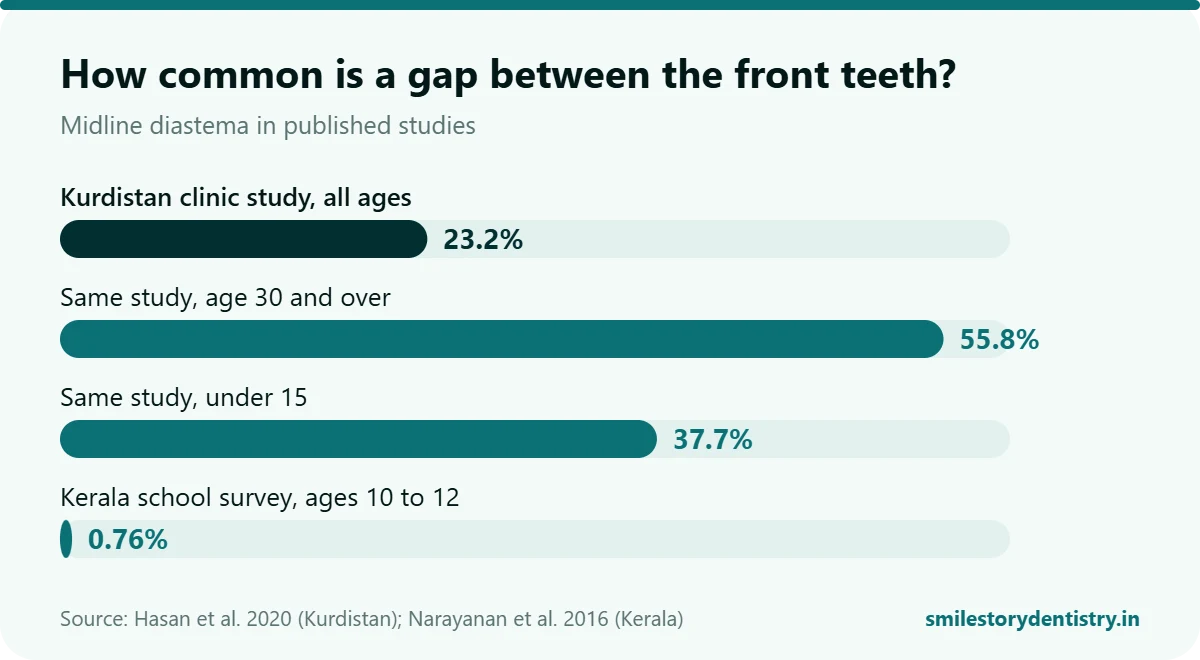
A gap that appears in adulthood, or one that keeps widening, is often caused by gum disease letting the front teeth drift and fan out. Closing it cosmetically without treating the gums first can fail, and the teeth may keep moving. If you notice a new gap along with bleeding gums, bad breath or loose teeth, get a gum check first.
Ways to close a gap between teeth
| Option | Gap size | Time | Notes |
|---|---|---|---|
| Composite bonding | Small (1 to 2 mm) | 1 visit | No drilling in most cases; may need touch-ups over years |
| Clear aligners | Small to moderate | 3 to 12 months | Moves teeth; needs a retainer after |
| Braces | Any size, plus bite problems | 6 to 18 months | Most complete fix; retainer after |
| Porcelain veneers | Small to moderate, plus shape or colour changes | 2 to 3 visits | Long-lasting; some enamel removed |
| Crowns | Gaps with damaged or very small teeth | 2 visits | Covers the whole tooth |
| Implant or bridge | Gap from a missing tooth | Varies | Replaces the tooth itself |
After closing a gap with braces or aligners, a fixed retainer is often used, because gaps are among the most likely to reopen.
Mock it up before you commit
Most guides list options. What patients actually want to know is how the result will look. Before closing a gap with bonding or veneers, ask for a trial smile: tooth-coloured material is placed temporarily over your teeth so you can see the new width in the mirror and in photos, and decide whether you prefer a full closure or a smaller gap.
This matters because closing a wide gap with bonding alone can make the two front teeth look too wide. Sometimes the best result spreads the space over four teeth, or moves teeth first with aligners. Ask about smile designing.
Gaps between teeth,
answered
Can't find your answer? We're one call away.
Call +91 76039 55135
Not necessarily. A stable gap with healthy gums is a cosmetic choice. A new or widening gap in an adult should be checked for gum disease.
In children aged 6 to 9 a front gap often closes as the canines come in. Adult gaps rarely close by themselves.
Composite bonding can close a small gap in a single visit. Larger gaps may need aligners, braces or veneers.
Do-it-yourself rubber bands are dangerous. They can slip under the gums and damage the bone holding the teeth, sometimes causing tooth loss. Always see a dentist.
It can, especially after braces or aligners. A retainer, often a fixed wire behind the front teeth, keeps the gap closed.
Research behind this guide
- Narayanan RK et al. Prevalence of malocclusion among 10–12-year-old schoolchildren in Kozhikode district, Kerala. Int J Clin Pediatr Dent, 2016
- Hasan HS et al. Pattern of distribution and etiologies of midline diastema among Kurdistan-region population. 2020
- Lombardo G et al. Worldwide prevalence of malocclusion in the different stages of dentition. Eur J Paediatr Dent, 2020
This guide is for general information and does not replace a dental examination. Every mouth is different, so book a consultation for advice on your own teeth.