Is every six months right?
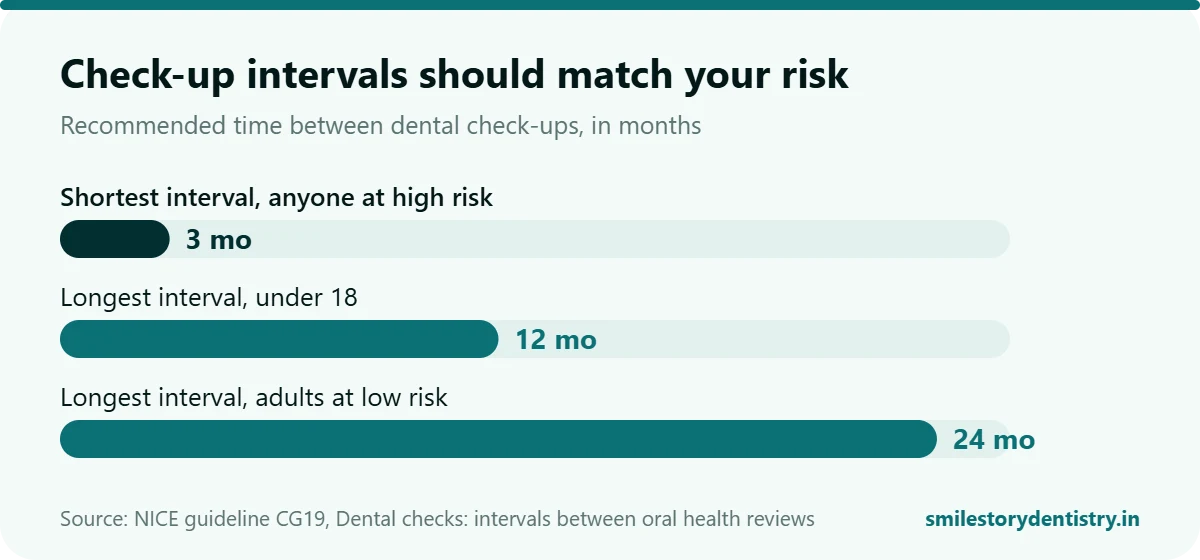
The 6-month rule is a reasonable default, but research hasn't shown it's the right interval for everyone. The UK's NICE guideline recommends dentists set each person's recall between 3 and 24 months for adults, and 3 to 12 months for under-18s, based on their risk. A Cochrane review found too little evidence to say a fixed 6-month interval is better or worse than risk-based intervals.
Who should visit more often
| Situation | Typical interval |
|---|---|
| Gum disease or after gum treatment | Every 3 to 4 months |
| Frequent new cavities, or a sugary diet | Every 3 to 6 months |
| Diabetes, pregnancy, or smoking/tobacco use | Every 3 to 6 months |
| Braces or aligners | Regular orthodontic visits plus 6-monthly dental checks |
| Children | Every 3 to 6 months, depending on decay risk |
| Healthy adults with no recent problems | Every 6 to 12 months, sometimes longer |
| Dry mouth from medicines | Every 3 to 6 months |
What happens at a check-up
- 1
Questions
Changes in your health, medicines and any problems you've noticed.
- 2
Teeth and gum check
Looking for decay, cracks, worn teeth and measuring gum pockets.
- 3
Mouth cancer screening
A look and feel of the cheeks, tongue, floor of the mouth and neck.
- 4
X-rays if needed
Usually every 1 to 2 years, depending on risk.
- 5
Cleaning
Scaling and polishing to remove tartar and stains.
- 6
Your next visit
Your dentist recommends an interval based on what they find.
Work out your own risk in 1 minute
Answer these honestly. The more "yes" answers, the closer to every 3 months your check-ups should be:
- Have you had a new filling in the last 2 years?
- Do your gums bleed when you brush? (see bleeding gums)
- Do you have sweet snacks or drinks more than 4 times a day?
- Do you smoke or use gutka, paan or khaini?
- Do you have diabetes or take medicines that dry your mouth?
- Do you wear braces, a denture or have implants?
- Has it been more than a year since your last cleaning?
No "yes" answers? Every 6 to 12 months may be enough. Several? Ask your dentist about a 3 to 4 month cleaning plan.
Dental check-ups,
answered
Can't find your answer? We're one call away.
Call +91 76039 55135
Yes. Cavities and gum disease usually don't hurt until they're advanced. Check-ups catch them when treatment is small and simple.
Most people benefit from a cleaning every 6 months. People with gum disease often need one every 3 to 4 months.
It depends on your risk. Many adults need bitewing X-rays every 1 to 2 years; people with frequent decay may need them more often.
For some low-risk adults, yes. Your dentist can tell you after looking at your teeth, gums and history.
Usually every 6 months, or every 3 months if they've had recent decay. See your child's first dental visit.
Research behind this guide
- NICE. Dental checks: intervals between oral health reviews (CG19)
- Riley P et al. Routine dental check-ups for maintaining oral health. Cochrane Database of Systematic Reviews
- World Health Organization. Oral health fact sheet
This guide is for general information and does not replace a dental examination. Every mouth is different, so book a consultation for advice on your own teeth.